


9th November 2017
ATF Wessex visit to Longleat

The Grove, Longleat
David Blake, who leads ATF Wessex, writes about the group’s Autumn visit to Longleat in Wiltshire
On the morning of 20th October, a few of us were logging on to the BBC Weather web page and wondering if we were going to be lucky or not. For some months, Julian Hight, Jim McConkie, Hilary Abbott and myself had been working on a plan to bring off the third Wessex ATF event. We particularly wanted this one to have a varied audience and, if possible, a larger audience than usual. We were lucky: the weather god did us proud.
19th October 2017
Rewilding and the Knepp conference lectures

Grazing cattle at Knepp
Jamie Simpson, who carries out arboricultural work at the Knepp Estate in Sussex, writes about the rewilding of Knepp, the influence of Frans Vera, and the Vera Conference at Knepp: ‘Freeing the Landscape: Grazing animals as ecosystems engineers’ (see link to presentations below).
The introduction of free-roaming grazing herbivores, extinct animals and a return to less interventional land management is commonly known now as ‘Rewilding’. It has been a hot topic amongst nature conservationists, land managers and farmers since the publication of Grazing Ecology and Forest History by Frans Vera in 2000 and more recently, promotion in mainstream journalism by George Monbiot.
9th August 2017
ATF Wessex: Managing visitors and veterans in Wiltshire
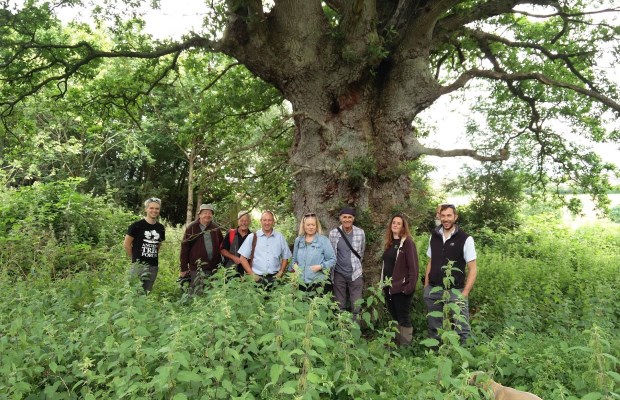
Jim Mullholland joined the ATF Wessex group for a field event in June to Southwick Country Park, a site much-visited by local people, to see how the veteran trees are managed.
Nestled on the outskirts of Trowbridge, Southwick Country Park is an impressive veteran tree site which can easily be overlooked. Along the former agricultural hedgerows the veteran oak pollards are becoming lost in forests of newly planted trees.
The country park was purchased by Wiltshire Council in 1989 with a view to developing a golf course. At that time strips of trees were planted to frame fairways and develop a number of holes within the loose agricultural field framework. When plans for a golf course didn’t continue, the land was instead used to create a country park for local residents.
8th August 2017
Training the trainers

Jim Mullholland, ATF’s Training and Technical Officer, writes about this year’s three-day veteran tree training course which took place after the summer conference at Epping Forest.
For this year’s course, we took advantage of the superb setting of Gilwell Park. Bookings were up and unfortunately we had to turn some people away due to being fully booked. We were fortunate to be joined by a number of international delegates, who brought a different perspective on things.
The three-day course was developed as part of the VETree project and has been designed to give the delegates the information, skills and experience to enable them to deliver a one-day course on valuing and managing veteran trees.
3rd August 2017
Improving protection for veteran trees in government policy
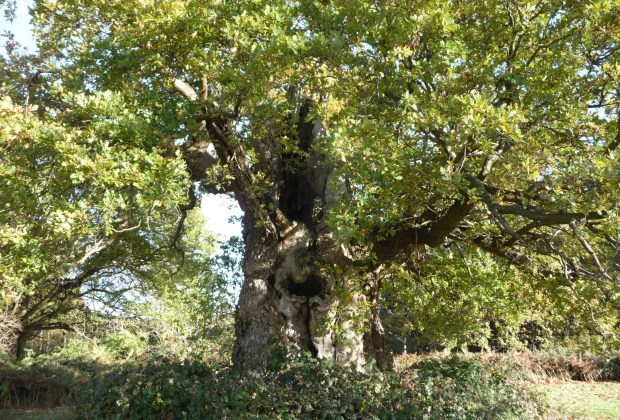
Aldermaston Park, where ATF campaigned to save ancient oaks from a proposed housing development
Caroline Davis, ATF’s Vice Chair, writes about her work earlier this year, to produce a response to the Government’s Housing White Paper, in order to improve protection for aged and veteran trees in government policy.
Working in close partnership with the Woodland Trust, we set out a full response to the Housing White Paper, ‘Fixing our broken housing market’. In particular, we jointly proposed an amendment to a key section (paragraph 118), in order to clarify the need to protect aged and veteran trees and ancient woodland as irreplaceable habitat. We put forward the following wording, and with strong behind the scenes lobbying by the Woodland Trust, we hope this will be accepted: ‘Loss or deterioration of irreplaceable habitats, including ancient woodland and aged or veteran trees found outside ancient woodland, resulting from development proposals should be wholly exceptional’
4th April 2017
A day in Dallington
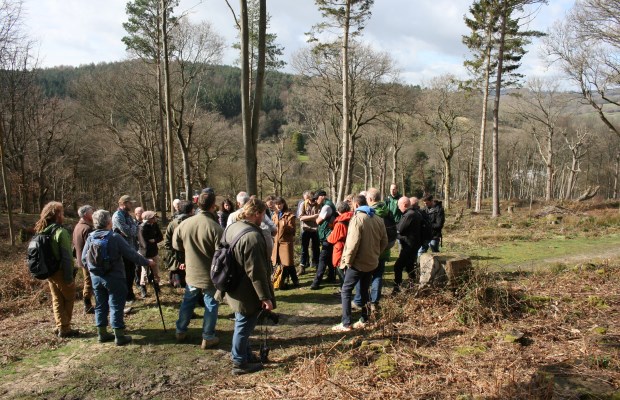
Coppice area at Dallington Forest
‘Woodlands are under-valued for their veteran trees’ said Jamie Simpson, in his introductory talk about the area of the Dallington Forest he manages. Forge Wood is made up of a mosaic of gill woodland (identified by its geological features of ridges and valleys with streams draining into them) with ancient and other veteran beech trees, ancient coppice and areas likely to be remnants of wood pasture.
Report by Hannah Solloway
Dallington, in East Sussex, is one of the most remote large forests in the South East of England, and it is fragmented through multiple ownership. Jamie (pictured below) has managed Forge Wood for 10 years, and had invited the ATF to see his conservation work. Management over the years has included removal of rhododendron, pollarding of some of the younger trees, management of veteran trees, maintenance of rides, and re-establishment of coppicing.
30th March 2017
Working with the National Trust to protect our ancient trees

ATF field visit with the National Trust at Borrowdale, Cumbria
Brian Muelaner, trustee of the Ancient Tree Forum and former Ancient Tree Adviser for the National Trust, writes about how the two organisations are now working together
As a tiny charity with huge ambitions the ATF has formed a number of partnerships with other organisations to help achieve its aims to:
- Champion the conservation and management of ancient trees and their wildlife, heritage and cultural values
- Develop and share knowledge and experience of ancient trees and awaken people to their beauty and value
- Prevent avoidable loss of existing ancient trees
- Secure and expand future generations of ancient trees
For over 20 years the ATF has worked with various partners in a number of ways, for example through producing joint publications with English Nature (now Natural England), and campaigning with the Woodland Trust. More recently we have sought links with like-minded organisations through the signing of Concordats in order to commit to a shared vision for ancient trees.
One of the most significant signatories has been the National Trust, due to their vast ownership of ancient and other veteran trees, their enormous membership and influence. In June 2015 the trust’s Director General, Dame Helen Ghosh, and I, then Chair of the ATF, signed and sealed the Concordat beneath the Ankerwycke yew, the very site on which it is believed the Magna Carta was sealed.
29th March 2017
First field event for ATF Wessex
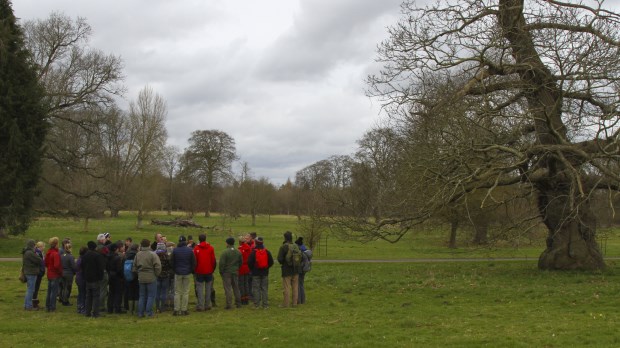
Kingston Lacy park
David Blake, who leads the new ATF Wessex group, joined local National Trust staff at the end of February for the group’s first field meeting, to Kingston Lacy and Holt Forest in Dorset
Kingston Lacy is one of the National Trust’s finest properties in the Wessex region and the regional and property staff had done us proud. After a brief welcome from myself we settled in the Mess Room to hear from Simon Ford (Wildlife and Countryside Consultancy Manager for the National Trust) about how ancient and veteran trees are managed within the Trust’s estate.
Integrating the specialist management of such important heritage assets (often, some of the trees around the great houses in the Trust’s portfolio are much older than the houses themselves) provides Simon and his colleagues with some real challenges. Many of these are around communicating the importance of the trees to colleagues and being able to meet the modern requirements for access, modern agricultural activity and public events in landscapes that were not designed with any of those things in mind.
16th March 2017
Managing standing dead veteran trees

Hampstead Heath tree in vascular decline following significant storm damage in the 1990’s.
David Humphries, Trees Management Officer for the City of London, writes about veteran trees retained as standing dead wood at Hampstead Heath
Although not an ancient tree the veteran boundary oak (Quercus robur) above has now been retained at an acceptable level of risk, as a standing dead structure for its niche habitat and biodiversity value. It was in vascular decline for a number of years following significant storm damage in the 1990s, and it eventually succumbed naturally due to loss of canopy and to a poor partial rooting environment. The oak sits next to a well-used path in an urban open space with regular footfall within a couple of meters.
17th November 2016
ATF autumn visit to Wimpole
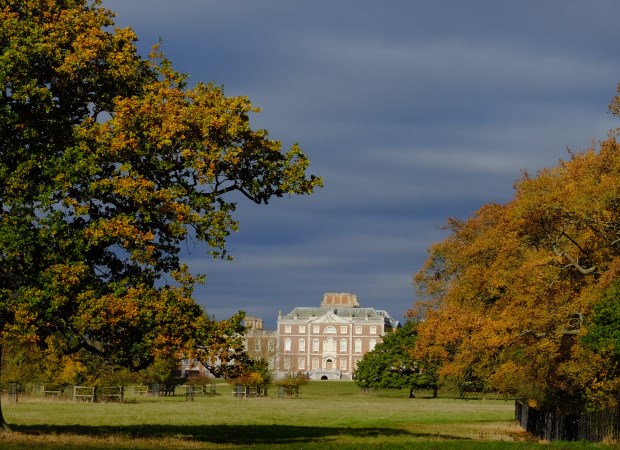
Wimpole
The Ancient Tree Forum held its October field meeting at the Wimpole estate in Cambridgeshire, now owned by the National Trust. Originally a small deer park (the first record is from 1302) surrounded by open fields, the Wimpole parkland has changed many times throughout its history.
Report by Hannah Solloway
Over the years, different owners employed different landscape designers and gardeners, who each left their mark on the landscape. One of the most influential was Capability Brown. The site is rich in veteran trees, and the surrounding farmland includes ancient boundary oak pollards. Another interesting aspect of the site is its saproxylic invertebrate fauna which is of exceptional richness, and includes European Red List species.
