


30th April 2025
ATF North East – Field Trip to Chillingham Castle – 11th April 2025
ATF North East Local Group – Chillingham Castle Field Meeting 11th April 2025
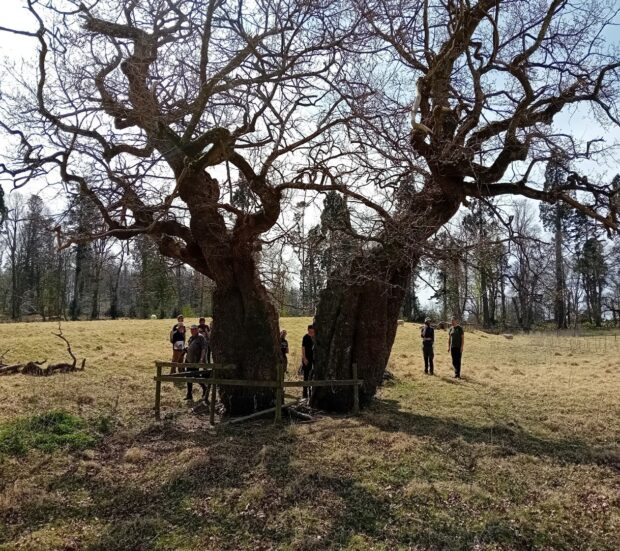
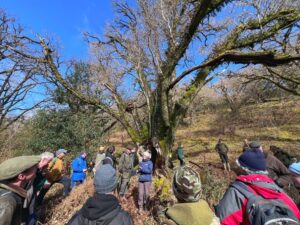
Following a warm welcome and a cup of tea, members of the ATF’s North East local group were led on a most informative and entertaining tour of the Chillingham Estate by its owner Sir Humphry Wakefield.
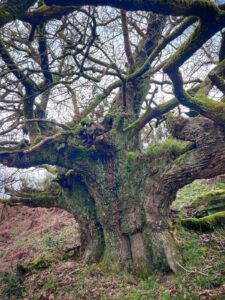
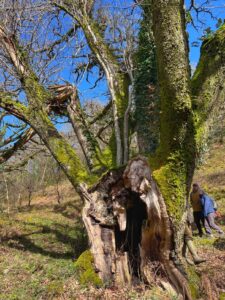
Beginning with an Ancient Yew tree of unique form and stature, Sir Humphrey showed the group many notable and veteran trees across the gardens and parkland, including majestic Douglas and Grand Fir with open grown forms, yews, sycamore, lime, and Oak. He carefully planned the route, saving the best until last, an amazing Ancient Oak tree described by many of the group as the finest ancient tree they had ever seen. While now a tree of two halves, it is thought to have originated as a single Pollard.
We would like to give a big thank you to Sir Humphry for his enthusiastic guidance and hospitality as well as to everyone who travelled to Chillingham to support this event.
THANKYOU!
Nick Johnson
ATF North East Local Group
northeast@ancienttreeforum.org.uk


15th October 2024
ATF North East – Field Trip to Allen Banks and Beltingham Yew – 30th August 2024
ATF North East Local Group – Allen Banks and Beltingham Yew Field Meeting 30th August 2024
Blessed with fair weather, the North East branch of the Ancient Tree Forum met at The National Trust property Allen Banks for its inaugural meeting on Friday the 30th August 2024. Following introductions and a group picture the programme began with a walk through the property’s woodland. The group was led by Chris Johnson and Paul Hewitt who took members on an informed stroll through the Ancient Woodland and along to the days next activity in the adjacent village of Beltingham.

Image credit: Nick Johnson
The group met at St Cuthberts Church where stakeholders of the Ancient Beltingham yew were also gathered. The Beltingham Yew, arguably the oldest tree in Northumberland and quite possibly the North East of England, stands proudly to the rear of the Church. It is preceded as you approach from the gate by slightly younger but no less impressive male and female guardian Yews.
The tree was nominated for the Woodland Trust Tree of the year in 2020; although it did not win that award it was never the less deemed significant enough for the Woodland Trust to acknowledge it. The Trust instructed Treescape Consultancy Ltd to inspect and carry out a report on the tree. In addition to this they gifted £500 for any management work that might be recommended to prolong its life. Arboriculture consultant Luke Steer subsequently produced a comprehensive report on the tree with a range of recommendations. Fortunately for us Luke agreed to meet with the group to talk through that report and discuss the issues raised.
The £500 donation was spent on opening the canopy of trees shading the North West side of the Beltingham Yew and removing the lower iron band which was probably installed around a hundred years ago. This band was beginning to prove potentially damaging to the tree’s health, constricting the tree, and preventing further development.
Other work which it is hoped can be carried out include soil analysis and the removal of other metal bands. This would only be possible following analysis of the tree’s structural integrity and an assessment of methods to effectively support the tree following the band removal. All these management strategies come at a cost, money that its custodians do not have. Our groups interest has sparked a renewed focus on this magnificent tree and a working group has been set up to work towards raising funds and commissioning work which will hopefully safeguard the tree’s future.
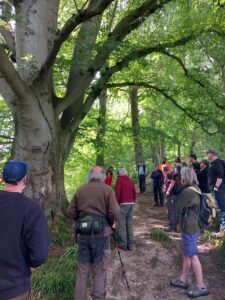
Image credit: Nick Johnson
A big thank you to all who attended our event on the 30th August, to Libby and Anne for helping enable our visit, the Reverend Canon Steve Wright of St Cuthberts for welcoming us to his church and to Luke Steer for a most illuminating and thought-provoking commentary and reflection on his Beltingham Yew report.
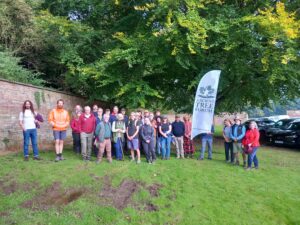
Image credit: Nick Johnson
Nick Johnson
ATF North East
northeast@ancienttreeforum.org.uk
23rd July 2024
ATF West Midlands & Worcestershire and Herefordshire Local Groups – Croft Castle Field Meeting 6th July 2024
ATF West Midlands & Worcestershire and Herefordshire Local Groups – Croft Castle Field Meeting 6th July 2024
The West Midlands & Worcestershire and Herefordshire ATF Local Groups tree walk involved approx. 25 attendees and took in some of the best ancient and veteran trees in the U.K.
The field visit was led by Archie Miles (representing the Herefordshire ATF Local Group) and the walk started at the Sir William Oak and then moved onto the Quarry Oak, which is estimated to be over 1,000 years old.

The Sir Thomas Croft Oak.
Image credit: James Butler-White
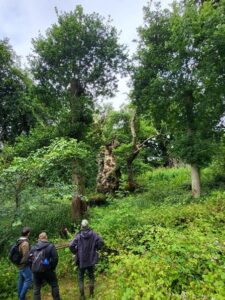
The Quarry Oak is estimated to be over 1,000 years old.
Image credit: James Butler-White
The walk then moved onto the famous sweet chestnut avenue, which is thought to date from c.1580 to c.1680 and is reminiscent of rows of giant ents across the countryside. Archie Miles provided an insightful talk on the history of the avenue, which then led to a discussion on the recent pollard management of the younger Sweet Chestnut within the avenue, by Jaime Simpson, who has worked on the Estate in the past pollarding the younger Oak and Sweet chestnut in the avenue and areas of woodland pasture.
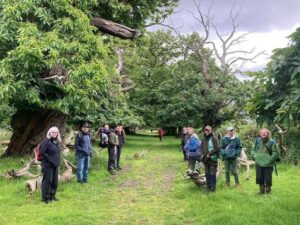
The sweet chestnut avenue and group photo
Image credit: Archie Miles
Our next stop was the orchard of ancient pollard hawthorn, thought to have been root stock for medlar pears. We were privileged to be given a short talk by Brian Muelaner on the history of these amazing ancient trees.
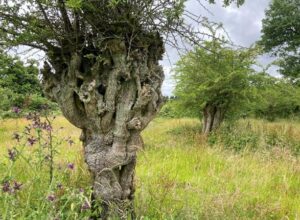
Example of the ancient Hawthorn pollards
Image credit: Archie Miles
After some great discussions, we walked onto an area of original woodland pasture which had some amazing, lapsed pollard oak, which was a great place to stop for some lunch and take in the amazing landscape.

Great place to stop for lunch and admire a lovely ancient oak pollard.
Image credit: James Butler-White
After admiring the ancient oak pollards and everyone replenished with food and water the walk moved on to the 28 hectares of wood pasture, which is full of ancient oak pollards and is also home to the “Candelabra oak” (which is estimated to be 700 to 800 years old). The group had some great discussions on woodland pasture management and the management of ancient trees. This was also a great opportunity to get a group photo alongside the Candelabra oak.
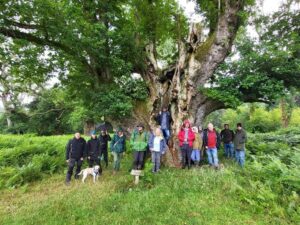
Group photo with the Candelabra oak
Image credit: James Butler-White
The final stop of our walk took in a triple avenue of Sweet chestnut where Callum Throw (Arb Innovators) gave a talk on photogrammetry and how to use Polycam or 3D Gaussian to create a digital archive of ancient and veteran trees. This was also a great opportunity to get a final group photo under the canopy of one of the many ancient Sweet chestnuts. In all, it was a great day spent with like-minded people who care for the conservation of ancient and veteran trees.
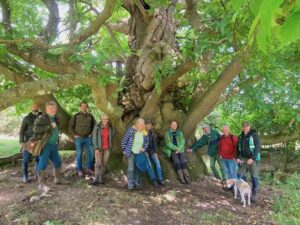
Group photo under an ancient Sweet chestnut.
Image credit: Archie Miles

Tiny planet image showcasing the majestic avenue of Sweet chestnuts at Croft Castle
Image credit: Callum Throw (Arb Innovators)
James Butler-White
ATF West Midlands and Worcestershire
23rd July 2024
Wessex ATF Local Group: field trip to Tortworth – 29th June 2024
Wessex ATF – Tortworth Field Meeting 29th June 2024
Tortworth Chestnut, to infinity and beyond!
Adorned by an uninterrupted sky of blue, The Wessex ATF were delighted to be joined by fourteen completely new members, bringing our group to forty strong inquisitive minds, from all walks and off-road mobility scooters of life, so a hearty welcome goes out to you very welcome saplings.
Though the kindness of Robert Moreton of Tortworth Estate, led by the expertise of Simon Bonvoisin and compassion of Jake Stow of Tortworth Forest Centre, we were all held in silence for the first half an hour at least of our day, not only from coming up to speed on the fascinating historical knowledge of this remarkable survivor, but quite simply by being in the presence of what is truly a humbling tree.

Tortworth Chestnut
Image Credit: Julian Hight
We approached single file through the wavering no-mow May and June meadow grasses and were met by the rickety but charming painted oak picket fencing being propped up by the gentle giant. The area in front sports a polished, exquisitely engraved slate sign, surviving beautifully from its inscribed date of 1800. The slate tablet references the tree as being 600 years old, being noted so much for its significance as to have a poem inscribed in its honour.
‘May Man Still Guard thy Venerable form
From the Rude Blasts and Tempestous Storm
Still mayest thou Flourish through. Succeeding time
And last long last the Wonder of the Clime’

Image Credit: Julian Hight
Mindful of the day’s busily planned logistics, we then headed five minutes up the road for a privileged sit down beside the estate’s beautiful private lake for our Renoir-styled picnic luncheon. This was followed by a brisk romp up the rural hillside, under strict instruction not to be distracted by the abundance of wonderful wood pasture, reclining and gracefully declining random specimen trees.
On arrival to Tortworth Forest Centre, Jake Stow took over the reins and we were wowed not only by his knowledge of the landscape’s history pre-dating Westonbirt Arboretum’s establishment, but also at the arboretum’s diverse and numerous collection of registered Champion Trees. Though on reflection what stands out is the unsung glory of the work going on behind the scenes. This Not-For-Profit organisation facilitates wellbeing programmes, such as a broad range of opportunities for individuals and groups to explore the critical subject of mental health through the use of hand tool working, landscape restoration and organised community social gatherings, set amongst an abundance of diverse specimen and veteran trees.
With a downward amble back to base camp and a bumpy scooter ride for Mike, our very own 73 year old veteran, off we fled till next time.
Daniel Part
ATF Wessex Local Group
23rd July 2024
Devon ATF Local Group: field trip to Horner Wood – 5th April 2024
ATF Devon Local Group – Horner Wood Field Meeting 5th April 2024
The General
Image Credit: Cheryl Silvawood
In April 2024, the Devon Ancient Tree Forum Local Group set off on a guided walk to visit Horner Wood on the north Somerset coast. Facilitated by Jon Burgess (Forestry Commission Woodland Resilience Officer) – as well as a full team of National Trust Rangers including Rob Manicom (Area Ranger) and Aislinn Mottahedin-Fardo – the Devon group was also boosted by the presence and knowledge of Jill Butler (Ancient tree, forest and wood pasture specialist), Rupert Baker (Chair of RFS Southwest), Julian Hight (Author and heritage tree specialist), amongst other industry consultants and tree afficionados.
Oak with Rowan cuckoo
Image Credit: Cheryl Silvawood
Jill Butler discussing cuckoo tree
Image Credit: Cheryl Silvawood
The group hadn’t moved far from its starting point as talk began around a couple of fantastic lapsed pollarded ancient oak trees – featuring impressive splits and hollows – with one oak in particular hosting a cuckoo rowan growing out from the middle of the oak. Jill Butler suggested the idea that a cuckoo tree could possibly compromise the growth and natural life cycle of its host tree, which then prompted discussions drawing to a consensus that the tree should continue to be observed for overshading by surrounding trees, as well as external conditions that could affect the integrity of the tree, i.e. trunk splits which could provide an opportunity for epicormic growth. The amount of response wood also needs to be observed over time, and as long as there is good growth in the lower canopy of the tree this is a process to be understood before intervening. Jon Burgess emphasised that the oak needed to be kept in full light to allow epicormic growth to be expressed while considering the functional units of the host tree itself, being mindful that there could be a catastrophic loss or failure in the event of a storm.
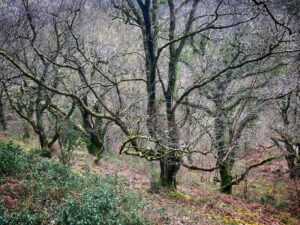
It is clear that Horner Wood’s pollards are rare and immensely valuable due to the location, quality, age and structure.
Horner Wood Pollards
Image Credit: Cheryl Silvawood
There was also a good example of a tree that had responded strongly to pollarding work carried out over 30 years ago, juxtaposed with another that had died. Generally, there is a high failure rate with pollarding larger veteran trees; thus managing surrounding external conditions like overshading instead would be a priority. VETcert Consultant Mat Shute, who has worked extensively on veteran tree management with Reg Harris, also spoke about the commitment and high costs to starting new pollards and that it is beneficial to phase cut and leave some original foliage that are more mildew-proof (Jamie Simpson technique), while keeping the tree’s vascular system going and retaining old growth while encouraging new growth. The key is instigating the right management early at the right age and unfortunately with Horner Wood’s tree structure, old lapsed pollards that are gone are possibly never going to be pollarded again but rather, managed as a habitat.
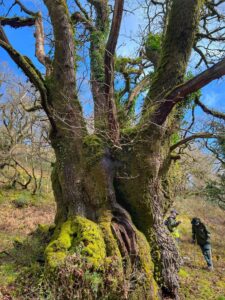
Image credit: Cheryl Silvawood
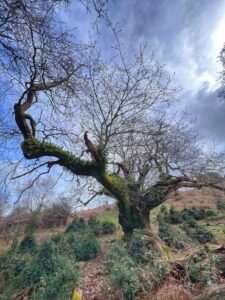
Image Credit: Cheryl Silvawood
Jill expressed that not enough new pollards are being created across our landscapes despite hedges being restored (while retaining trees amongst them). Mat mentioned that there is a big move on agroforestry in France, to start re-pollarding or establishing pollards, and hopes there will be value in product in the future to sustain the historic practice and uphold tradition at the same time, while keeping an eye on what the future might bring in terms of energy and food sources.
The popular question of ivy on veteran trees was also discussed; the denser ivy gets the more shading occurs on potential epicormic growth if a tree’s crown embarks on the retrenchment (reorganisation) process, leading to management that has to be sensitively undertaken.
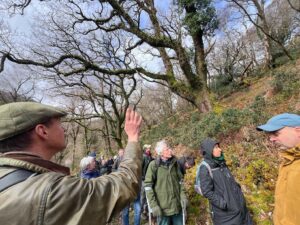
Jon Burgess speaking
Image Credit: Cheryl Silvawood
Another interesting topic of discussion was veteran trees evolving across areas between woodland habitat and open heathland, both habitats being nationally and internationally important. Where boundary is questionable, should we let woodland expand up the slopes and lose vital heathland habitat, or do we control the spread of trees (regeneration) up the slope?
Jill suggests “We’ve compartmentalised things into woodland and heathland and it’s a manmade construct. I’m not a fan of the term ‘woodland’ anymore, because it’s too focussed on closed canopy and we should be thinking about this as a massive wood pasture system open to grazing including beneficial managed deer populations. The habitats should be able to dance across the landscape creating a more open mosaic. Beech, for example, will prefer more closed canopy, whilst oak and other species clearly want to regenerate out in the open areas.”
The group rounded up the day with a visit to the impressive 500+ year old oak called ‘The General’, which is situated firmly on a scree slope.
The Devon ATF Local Group would like to thank the National Trust team at Holnicote for guiding the walk, generously sharing information about their management work and ideas for the future.
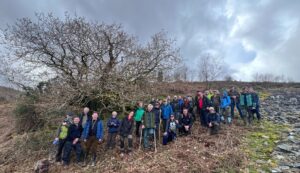
Devon ATF in front of The General at Horner Wood
Image Credit: Cheryl Silvawood
Cheryl Silvawood
ATF Trustee
ATF Devon Local Group
12th January 2024
Essex ATF Local Group: field trip to Furze Wood – 16th December 2023
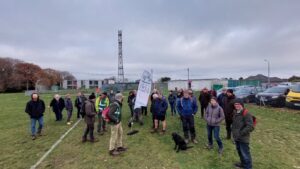
Image credit: James Chambers – Attendees gathering with the volunteers at the event meeting point, by our prized ATF flag!
The Essex ATF local groups final veteran tree walk of 2023 involved approx. 35 attendees, and a multitude of truly magnificent trees at the wonderful Furze Wood, Mistley.
This location is host to several ancient veteran oak pollards, and something of a hidden gem as many of the attendees hadn’t been aware of the location and its trees before the event.
Image credit: James Chambers – heading off from the first tree of the event, “Mistley’s Majesty”.
We started the walk at “Mistley’s Majesty”, a lovely hollow old oak pollard with lots of character, before heading into the woods. There was a rugby match shortly after this photo was taken, but due to our careful planning and ‘precise time management’ (ahem), we were already in the woods by then.
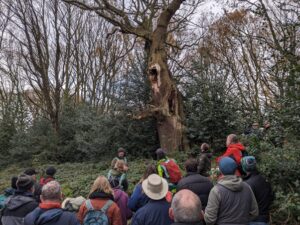
Image credit: Steve Woodley – talking through the many interesting features of a veteran oak tree.
Our next stop was by another lovely old hollow oak which has historically lost limbs both up in the crown and lower down the stem, providing lots of wildlife habitat potential.
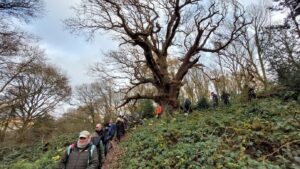
Image credit: James Chambers – “Big Foot”, a mighty ancient veteran oak pollard of national special interest, with the attendees slowly tearing themselves away!
Big Foot, a truly magnificent ancient oak pollard prompted much discussion and interest. While the group were admiring the tree, a resident from a nearby property noticed us and called out “…that tree is 700yrs old!”. We were grateful for the advice, and certainly couldn’t argue with the estimate!
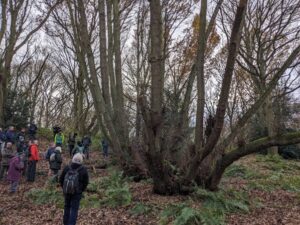
Image credit: Steve Woodley – admiring a huge old alder coppice!
We then moved on to a remarkable alder coppice with a huge basal circumference. There is another, smaller alder coppice not far away as well. This prompted interesting discussion about the history of the site, with ancient coppice and pollards in fairly close proximity. How had this unusual combination of circumstances come about, over the ages?
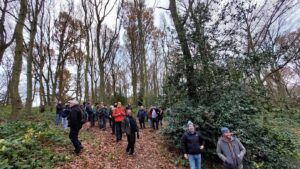
Image credit: James Chambers – A mirthful moment during our exploration of the woods.
It’s important to thank all the attendees for making the event so enjoyable. There were many interesting discussions with questions and answers from all participants, particularly some knowledgeable locals who shared information about the remains of some military buildings which are dotted in between the trees here and there.
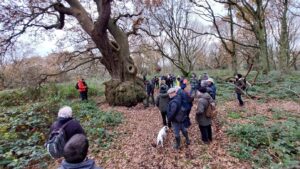
Image credit: James Chambers – amazing growth around the base, visually similar to “The Crinoline Lady” at Thorndon Country Park.
Those of us who’d been on one of our earlier walks this year recalled “The Crinoline Lady” from Thorndon Country Park and noted the visual similarities with another old oak pollard at Furze Woods. We discussed the various theories about this unusual kind of growth might be explained.
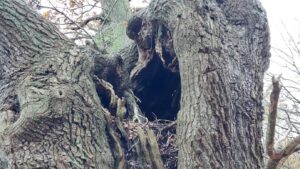
Image credit: James Chambers – An impressive adventitious root in “Mistley’s Monster-ess”
Another interesting feature was some well-established internal adventitious rooting in one of the large old oaks. A remarkable demonstration of natural recycling taking place as the tree draws on the nutrients becoming available decomposition of internal wood, which once formed the trunk of the tree itself!
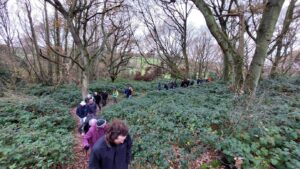
Image credit: James Chambers – The group following a trail through the woods!
Furze Woods isn’t a huge site, but there is lots to see. There are several well worn tracks meandering around the site, which doubtless provides habitat for a range of wildlife throughout the year.

Image credit: Steve Woodley – all the attendees gathered by “Old Knobbly”, another magnificent ancient oak pollard of national special interest.
One of the highlights of the day was meeting “Old Knobbly”, another important, named tree of national special interest, and the most famous tree at the site.
This old beauty prompted lots of discussion about how best to manage ancient and veteran trees, in order to prolong their lives as much as possible.
The tree has been suffering physiologically of late, probably due to a combination of factors such as recent hot summers, soil compaction and sadly, vandalism as it has been set on fire in the past.
Perhaps some mulch and a low fence with some signage explaining the importance of this tree (and ancient trees in general) might help?

Image credit: A helpful attendee using James Chambers phone. The Essex ATF volunteers (minus Matt who sadly couldn’t make it).
Once again, we’d like to thank all the attendees who make these events so interesting and enjoyable. This was a particularly interactive event, exactly as we’d hoped and always seek to encourage.
Lots of really interesting questions, local knowledge and valuable input from another fabulous group.
We’re very much looking forward to at least four events in 2024 and encourage anyone who has any interest in visiting and discussing ancient and veteran trees to join us, no tree expertise necessary! Of course, fellow arbs are also very welcome!
Hope to see you in 2024, tell your friends!
Steve Woodley and James Chambers
7th December 2023
Essex ATF Local Group: Field Trip to Danbury Lakes Country Park- 29 October 2023
Ancient Tree Forum Essex Local Group visit to Danbury Lakes Country Park
near Chelmsford Essex.
Sunday 29th October 2023
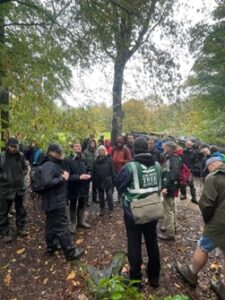
Image credit: Bo Chapman
Building on the success of the first two walks held earlier in the year, it was time for the Essex chapter to host another event. After various sites were considered, Danbury Lakes was settled on.
Owned by Essex County Council since the late nineteen forties it has been a Country Park since 1974. Covering a mere twenty five percent of the former grounds it is still an impressive place.
In its early years it was developed into a deer park and hints of those times are left in the topography of the land. It boasts three impressive lakes which are thought to date from that period.
The ATF were well represented on the day with a decent amount of volunteers on hand to help guide the attendees through the walk. Jim Chambers, Steve Woodley, Matt Searle, Annie Hooper and Robin Hellier were all present in their `Low Viz’ tabards.

Image credit: Bo Chapman
Whilst the volunteers waited for attendees to arrive the heavens decided to open. The rain began to fall and would provide a backdrop for the entire duration of the visit. But still people began to arrive. In ones and twos the group started to grow, till eventually we had approximately thirty five people ready to go.
Initial safety briefing completed the group headed off led by ever enthusiastic Jim Chambers.
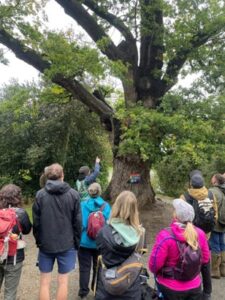
Image credit: Bo Chapman
The first main stop was at stunning old standing dead oak. A shadow of its former self, Its hollow form polished by thousands of hands and feet, it was highlighted as an example of the cultural importance of standing dead trees. One of the volunteers was actually photographed as a five year old in that very tree, it being present in its current form fifty years ago at least!

Image Credit: Bo Chapman
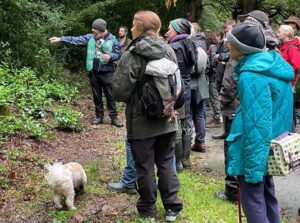
Image Credit: Bo Chapman
Next we headed to the bottom lake and started looking at some oak pollards of venerable age. This allowed for discussions on various topics covering management pressure including compaction and disease.
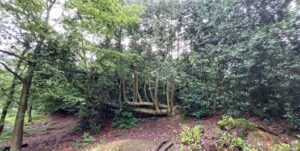
Image credit: James Chambers (on an earlier site recce when it wasn’t raining!)
A little further on some oak and beech trees offered up some resident fungi, and nearby a fallen ‘phoenix’ holly stimulating yet more debate.

Image Credit: Bo Chapman
Pressing on we came to the Ice house. A fantastic reminder of the days gone by and useful aid in helping to understand the landscape. Moving on we paused at yet more great old pollards and made our way towards the middle lake. Oak after pollarded oak was paused at, discussed and admired.
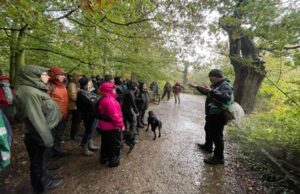
Image Credit: Bo Chapman
The weather was very wet, to say the least, so we were not able to spend as long as we might have with some of the trees, and decided to omit parts of the planned walk for practical reasons. This meant that we missed some of the great individual trees, so we may well return to this lovely park in the future.
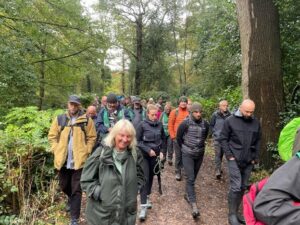
Image Credit: Bo Chapman
At this point I would just like to say thank you to all those people who attended that day. We were so lucky to have many people attend who are not directly involved in the tree Management world, especially on such a rainy day!
As well as interested professionals we also had forest school educators and members of the general public in our ranks so the age spread was impressive. We are very pleased to see our desire not just to preach to the converted coming to fruition. Everyone stuck out the weather and seemed to get a lot out of the day.
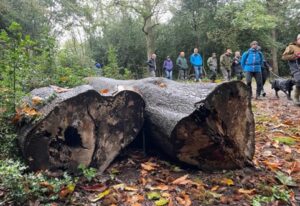
Image Credit: Bo Chapman
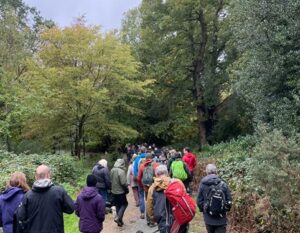
Image Credit: Bo Chapman
Passing the top lake we choose a careful route to avoid a couple of trees we planned to return to, as perhaps the highlight of the walk. But the upper woodland contains several stunning veterans, so we still had plenty to see and discuss.

Image Credit: James Chambers (on an earlier site recce when it wasn’t raining!)
Several large oaks and one large Sweet Chestnut in particular are worth a visit to the site on their own and yet they are surrounded by many more fantastic examples. Tree after tree allowed for questions to be voiced by the group, leading to interesting discussions, something we’re always keen to encourage between all parties. These events are for everyone to enjoy.
We arrived as another remarkable pair of trees, a dead beech monolith and huge old oak pollard, where the forest school team were kind enough to share a story about the old beech tree. Many years ago before the war, many couples had carved their initials together in recognition of their relationships, and sadly this would be the last time many of those couples were together, a poignant reminder of the cultural significance that large old trees often have.
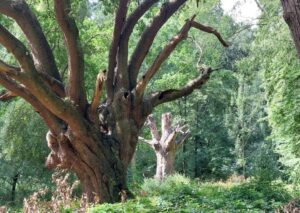
Image Credit: James Chambers (on an earlier site recce when it wasn’t raining!)
The dead beech tree itself also offers more information, as well intentioned management some years back is very likely the cause of the tree’s demise. Another useful lesson in how we are still learning about the best and most appropriate ways to manage old trees, and when intervention is actually necessary.
Later we finally arrived at what was the perfect end point for the walk. As we have in the past, we had prepared a ‘secret’ level 2 (and a brief level 3) for anyone who wanted to stay, but felt that the continuous rain would probably have deterred most on this occasion. And yet the vast majority of people wanted to continue even with poor weather. A testament to how much people had taken from the day.
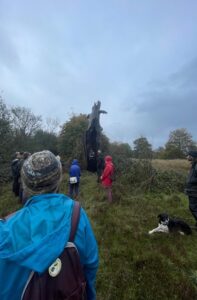
Image credit: Bo Chapman
So, we did carry on, not quite as we had planned, but visited another area of the park containing several lovely old trees including one more hollowed out old monolith that was another focus of interest.
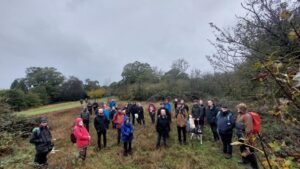
Image credit: James Chambers
All in all this was another great success, despite the inclement weather, and the ATF Essex chapter extends our sincere gratitude to all the attendees, who make these walks such an interesting and rewarding experience for all involved.
We are already looking forward to our next veteran tree walk this year, details to follow shortly!
Steve Woodley and James Chambers
5th October 2023
Yorkshire East Midlands Local Group: Field Trip to Fountains Abbey- 21 September 2023
Many thanks to National Trust Fountains Abbey and Studley Royal for hosting the ATF Yorkshire & East Midlands Field Meeting on the 21st September 2023. Fabulous trees and great discussions ranging from tree safety and saproxylic beetles to historic landscape considerations and managing the next generation.

ATF Yorkshire & East Midlands Local Group at Fountains Abbey
Photo Credit: Liam Plummer
ATF YEM
21st September 2023
Essex ATF Local Group: Field Trip to Thorndon Country Park- 12 August 2023
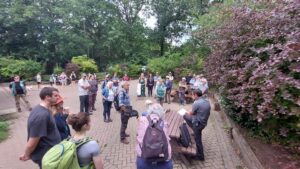
Image credit: James Chambers
This was the second event to be organised by the Essex branch of the ATF. Volunteer organisers that day were Annie Hooper, Jim Chambers and Steve Woodley. Also hosting the walk was Geoff who is a member of the ranger team responsible for the management of the site.
I would like to put on record our collective thanks to Geoff whose site knowledge allowed attendees to gather an understanding of Thorndon that would not have been possible in his absence.

Image credit: James Chambers
The day began with the standard safety briefing and sadly had to include the mention of the presence of Oak Processionary Moth. Thorndon, like so many similar sites around London has received its fair share of the unwelcome guest.
Safety briefing complete Geoff was introduced to the group and began by giving a brief but fascinating history to the site. Covering some 243 hectares, once owned by Lord Petre it was developed as a Deer park from around 1414 onwards. Built around the original Thorndon Hall it was eventually re landscaped by the famous Capability Brown in the 1760’s. This rich history has led to a vast collection of venerable old trees. The group was in for a long day!
Gently marshalled by the ATF volunteers in their `Low Viz’ green ATF tabards, the group headed off and assembled around the first tree, a stunning Hornbeam pollard, apparently a firm favourite of young visitors as its lower branches are easily accessible!
The first stop allowed the group to begin to understand the modern management pressures sites like these face.
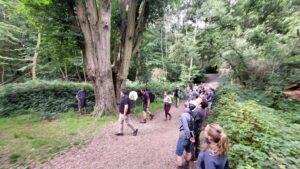
Image credit: James Chambers
Moving on we arrived at the first showstopper. An absolutely huge old Downy Birch, a true survivor. So big at the base, from a distance you would never think it a Birch. Questions started coming thick and fast and Geoff and Jim did a great job in answering them.
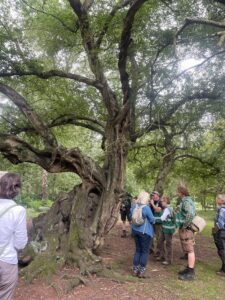
Image credit: Bo Chapman
At this point it’s worth mentioning a little about the group. Building on the initial success of our first visit to Weald Country Park back in June of this year, it was fantastic to see so many people turn up to this event. 35 in total, the age range went from early twenties to far more advanced years and everything in between. Interested amateurs mixing with experienced and newly qualified professionals alike. Whilst there were many notable people present, one who stood out was Anthony Mills. Having his vast knowledge accompany the walk was super useful and our collective thanks goes to him for his extreme effort on the day. The distance covered and the terrain led to a challenging physical day even for the younger participants!

Image credit: James Chambers
The next group of trees were a stunning example of veteran coppice, pollard and coppard Hornbeam. A fantastic example of differing management practices throughout the previous centuries.
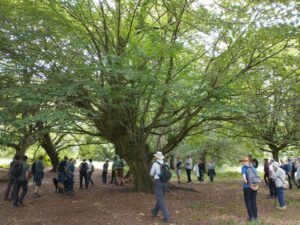
Image Credit: Steve Woodley
This area gave a wonderful feeling of place, it allowed people to really tie in the trees to the landscape. Various discussions looked at the tree spacing and historic techniques used in the creation of wood pasture and the demands placed on such an environment.

Image Credit: Bo Chapman
Also of note on this section is the Crinoline Lady. A majestic old Oak admired down the generations for its unique basal growth. Theories abound as to how this particular growth habit came about.

Image Credit: Bo Chapman
When Geoff and Jim had designed the walk they broke it into two levels of involvement, with a ‘secret’ third level to unlock for those who made it through the second! Level 1 complete, the group made a pit stop at the visitor centre for well-earned refreshments. Half hour later Jim invited the group to begin level 2 and approximately 20 people joined us as the walk headed south.

Image credit: James Chambers
Level 2 turned out to be the land of the giant Oaks, tree after tree came into view and led to some great discussion on how to approach different aspects of veteran management and the current thinking on certain practices. Whilst dominated by big Oaks, the area also contained a couple of thumping great Horse Chestnuts, and some remarkable hornbeam pollards.

Image Credit: Steve O’Reilly
Sadly, one large chestnut had recently failed at the base and lay on its side, its crown still towering above the attendees, but it led to some great conversation about habitat value of veteran naturalised species and the possible causes that led to the trees sad uprooting. Both the standing and fallen examples were riddled with cavities and torsional fractures.
Another member of the group, Duncan Fisher, an entomologist for Essex County Council highlighted the current understanding of invertebrate interaction with Horse Chestnut which was really interesting and gave greater understanding of the complex life that is hosted on these trees.
Level 2 was completed by a visit to Harold, a very large, sadly dead, example of a previous historic attempt at veteran management. Thought provoking.
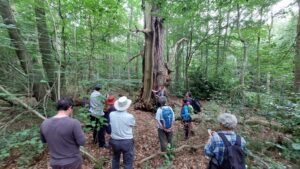
Image credit: James Chambers
Jim revealed the ‘secret’ level 3, and with a promise of no level 4, invited any who wished to continue to visit the most incredible aerial root, something Ted Green had apparently said was the biggest he’d ever seen, some 20 odd years earlier.
Level 3 saw the exit of the majority of the group. In fairness to them, we had by then been walking for many miles. Farewells swapped, the last few die-hards headed back into the woods for a shorter final section.
While marvelling at the spectacle of this incredible aerial root, Duncan remembered that there was another tree somewhere nearby with a similar feature, and so after a brief discussion between the group we agreed to begin level 3B and go on a search for this other tree.
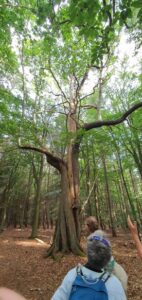
Image Credit: Steve O’Reilly
After a brief search Duncan did successfully locate the tree, another remarkable sweet chestnut hidden away in the woods. Finally, we all agreed enough was enough, and made our way back to the car park, using metaphorical blinkers to avoid being side-tracked by an almost continual array of other interesting trees and features on the way.
All in all the whole day was almost exactly 8hrs long, and based on the wonderful feedback and great levels of enjoyment we all experienced, the second Essex ATF field meeting was another great success.
Once again, we’d really like to thank everyone who took part, these events are such a pleasure because of the interaction between the attendees and volunteers as we enjoy the incredibly special veteran and ancient trees, wildlife and habitats and other wonderful features of the Essex countryside.
We are now planning a further 2 events this year (details to follow shortly) and look forward to welcoming everyone to join us once again soon.
Steve Woodley and James Chambers
27th July 2023
South Weald Park Fire Prevention in Ancient Oak Tree
South Weald Park near Brentwood in Essex is one of Essex County Council’s country parks, it has a good collection of ancient and veteran trees with many Oaks in the wood pasture area, these are in various states, many are old pollards some of which are hollowing.
About 10 years ago we were asked to advise on a tree that had been recently burnt, the tree, a large Oak pollard, was hollow with a small opening at ground level and a large opening at about 4 metres height, deadwood and material had been placed in the cavity from above and below and set alight, the lower opening acted as a vent and the upper as a chimney and according to a witness flames went metres in the air from the upper opening, the fire burnt itself out but later another attempt was made to build a new fire which luckily was prevented by the arsonists being disturbed.
I thought about various methods to prevent another fire and also the natural cycles of decay, hollowing and ageing of trees and how we might try and replicate these as well. The importance of wood mould occurred to me and how this is so valuable in hollow trees, the fact that it is naturally moist and therefore fireproof to a degree lead me to think of the properties of well-rotted woodchip as a substitute which may eventually replicate wood mould.
We could climb into the hollow stem from the upper opening and assess the cavity, any creatures in there at the time of the fire would have either left or perished but we checked in case any new inhabitants were there, the fire had completely charred the inside wall but it was still reasonably thick enough that the heat hadn’t killed the cambium, although this may occur in very thin walled hollow trees.
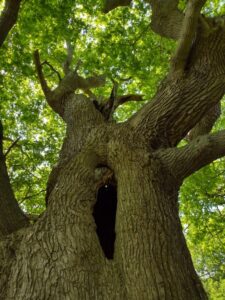
Image Credit: ATF
Fire damaged ancient oak, Weald Country Park
The park rangers had a supply of woodchip from the park trees which was brought to close by, this was to avoid importing any pest or disease on woodchip from afar but if you doing this any moist, well-rotted woodchip is better than none! We climbed into the cavity and attached 1 inch weldmesh which had been cut to fit around the inside of the lower opening with enough to allow the use of galvanised staples to attach it inside, this was to prevent the removal of the weldmesh. A pulley and small lowering rope were installed in the crown above the upper opening and the woodchip was hauled above and tipped into the cavity until it was full. The weldmesh prevented the woodchip from spilling out and the weight of the woodchip secured the weldmesh from tampering, within a small time period the weldmesh had surface rust and it was almost unnoticeable. This method is fairly flexible providing there is stable wood to attach the weldmesh, the gauge of the materials used can be varied according to the size of the area to cover but too thin a gauge may be easily damaged and too big mesh may leak woodchip.
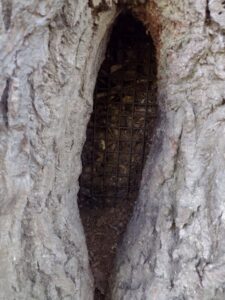
Image Credit: ATF
Weldmesh inserted to retain woodchip
Consider management plans for any trees at risk of fire damage and especially consider the availability of fire-starting materials, arsonists are very resourceful!
Deadwood piles and dead hedges are easy targets and we have seen them used many times often with very damaging results to trees, the ecological benefits of these alternatives to chipping or controlled fires may be outweighed by their potential to be used by arsonists.
10 years on and the Oak is looking great and the cavity is still full enough to prevent any further fires.

Image Credit: ATF
Establishment of a native hedge to reduce compaction around a veteran oak at Weald Country Park.

James Curry
jamescurryarborist@outlook.com
