


16th October 2026
ATF Kent Report – Visit to Penshurst Estate; 3 Oct 2026
By Richard Arnold (ATF Kent)
Volunteers: Dr Jon Heuch; Rick Vallis; Clive Mayhew; Richard Arnold
Penshurst Estate Hosts: Ben Thomas; Andrew Stronghill
Attendees: 23 total + 3 dogs!
Weather: Warm and sunny
The Penshurst Estate dates from C14th and was owned by Henry VIII at one time, before it passed to the Sydney family, who own it to this day and who very generously allowed us to run this event with the support of their team.
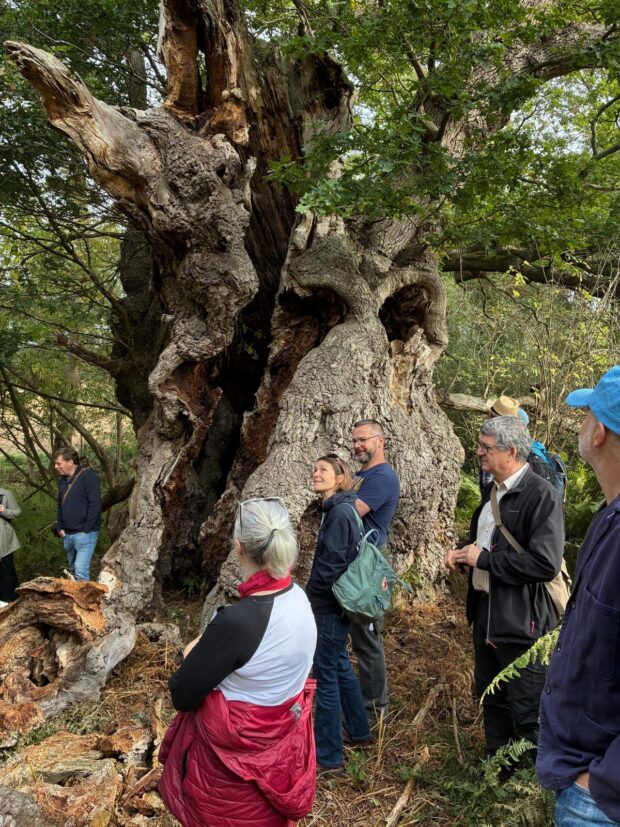
Image: Ancient oak (Quercus robur) at Penshurst Estate (credit: Richard Arnold)
The meeting point was the forestry yard car park at the north end of the estate. This is the private area of the estate, although it is used for bushcraft courses and the like.
First stop was Collinses Tol – an area of veteran / ancient sweet chestnut and beech which had been planted as deer shelter, originally back in the time of Henry VIII. We observed that the chestnuts were dying back (possibly retrenchment in some cases and general decline due to drought stress, compaction and disease in other cases). Despite this, the habitat value was enormous due to the myriad cavities and durability of the timber. Sweet chestnut timber from this area of the park had been used to construct the roof of Barons Hall – the Estates medieval banqueting hall. There was also a great, layering beech tree, complete with decay-nesting hornets!

Image: Layering beech tree (credit: Richard Arnold)
Next we visited a veteran oak tree, which despite being estimated (via Bristol Trees calculator) to be about 400 years old, still had very little decay. We discussed the young beech and holly which was growing up through the crown and some recent(ish) haloing work. A game of ‘pollard, or not-pollard’ was born, as Clive Mayhew debated whether or not it was a worked tree.

Image: Veteran oak (Quercus robur) (credit: Richard Arnold)
The morning then progressed to take in another veteran sweet chestnut before going on to see the veteran silver birch. This was a beautiful tree, complete with historic artefacts! (see photos). There was an unplanned stop adjacent to this tree, where Clive discovered a ‘walking beech tree’ which had collapsed and layered in several directions, giving rise to well-established trees, reminiscent of a spider plant!


Images: Veteran birch at Penshurst Estate (credit: Richard Arnold)
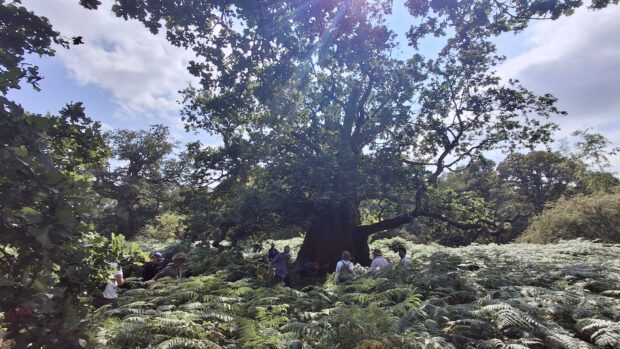
Then came what I think for most of us was the highlight of the day – an ancient oak (Q. robur) which measured 11.8m (@1.5m) – Aljos Farjon had measured it last in 2014 at 11.26m. The Bristol Trees estimate of its age (given the location) was between 1050 and 1498 years. The tree appeared to be thriving in its location and vitality/ condition of the crown was very good. The tree was almost certainly a ‘worked tree’ and Clive thought he had ascertained where a ladder would have been placed and where a worker would have braced themselves to swing an axe. Much discussion of the use of lateral oak beams in ships hulls and the like. We were all reluctant to leave this wonderful ancient behind us!
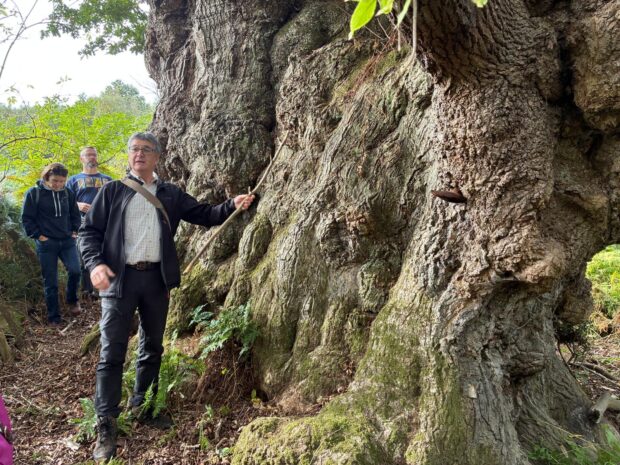
Image: Ancient oak (Quercus robur) (credit: Richard Arnold)
We ended the morning session by comparing two veteran (one arguably ancient) beech trees. The older had clearly been pollarded and was also sporting a profusion of Ganoderma (applanatum) fruiting bodies. There was debate as to whether the younger tree had been worked – which led to Clive speaking about the use of beech in WWII to make plyboard for, amongst other things; Mosquito light-bomber planes!
We re-grouped at the café near the main house for lunch and then into the afternoon session.
We walked north through the old grade I listed parkland to look at a very large uprooted oak, which had apparently had a full crown and appeared to be of good vitality before it fell a few years back. Looping back round, we stopped at the remains of the bolling of the Sydney oak (or Bear oak), which had been over 1000 years old when its last bough finally failed in 2016. One of its progeny grows adjacent (many other seedlings were shipped around the country and the world….

Image: The Sydney Oak (credit: Richard Arnold)
We then entered a tree archaeology phase as we looked at ancient sweet chestnut stumps. Clive Mayhew had brought with him a Gunter’s measuring chain but found that the distance between stumps did not measure at a standard chain length. Reflecting on it, he said that the chestnuts (which were felled in the 1970’s) pre-dated the standardised chain (1620) and were therefore probably laid out using a locally used measuring chain. There was some debate as to whether epiphytes/ cuckoo trees should be allowed to grow within the stumps, or whether the archaeology of the stumps should be preserved for longer by the removal of such pretenders. Clive mused that a building foundation of this age would likely be listed but that a tree stump (even part of a historic avenue) is generally overlooked and rarely protected.

Image: Sweet chestnut stump (credit: Richard Arnold)
From here we visited Barons Hall – the C14th banqueting hall, complete with sweet chestnut roof before heading into the formal gardens to see a Ginkgo growing intimately alongside the house (probably C18th planting) and a veteran (maybe pollarded) sweet chestnut growing intimately adjacent to the garden wall!

Image: Roof at Barons Hall, constructed with sweet chestnut (credit: Richard Arnold)
We finished with tea and cake at the café, kindly sponsored by Rick Vallis (Silva Woodland Mgt), who is the forestry consultant for the estate (and a new volunteer with Kent ATF).

15th October 2026
ATF Wessex Report – Visit to Longleat; 9 Oct 2026
By Julian Hight (ATF Wessex)
Longleat is set in 1,000 acres of parkland with a history dating back to 1275 when it was a monastery for a Priory of Black Cannons. Following the dissolution, the estate was bought by the Thynne family for the princely sum of £53, who have held unbroken ownership ever since.

Image: Longleat House (credit: Angus Rankine)
Wessex ATF team arrived on a wet and windy morning to greet a full quota of 40 attendees from a broad range of backgrounds across the tree world.
We set off to walk the parkland from the grand views of Heaven’s Gate along steep, undulating ground and saw an array of veteran and ancient oak, beech, alder and lime trees, thought to date to Capability Brown’s re-fashioning of the grounds in 1754. Our host, David Abraham – Aboricultural Supervisor at Longleat – shared some valuable background on estate management and the wildlife therein, including the return of pine martin and beaver.

Image: ATF Hug (credit: Angus Rankine)
In the afternoon, we continued to ‘the Grove’ to see sweet chestnut, lime, field maple and ancient hollow oaks, finishing with Longleat’s largest girthed and probably oldest oak – the magnificent Lion of Longleat (you can hear the lions in the safari park roar from here). We measured the oak, and found that it had grown 10cm in circumference since our last visit 9 years ago, meaning its annual ring width had increased, on average, by 3.5mm a year. Multiplying that by 750 (years) gives us the tree’s diameter, and we’re back to the estate’s monasterial beginnings.
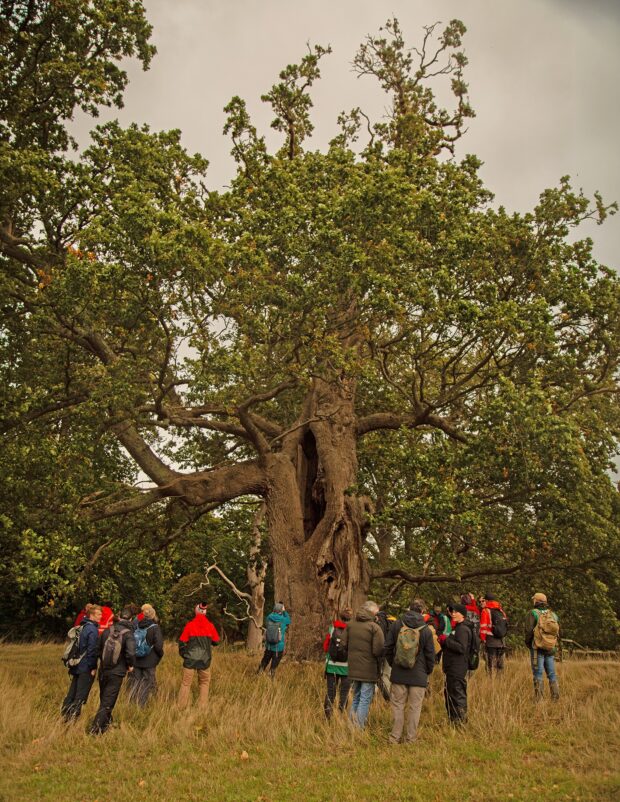
Image: The Lion of Longleat (credit: Angus Rankine)
At the end of the day, several of the group took the optional short drive to meet the estate’s oldest tree – the ancient Longleat Yew. Also known as the Temple Yew after the village it stands in (named after the Templar Knights that settled there after the Crusades), the 8.5m girthed, hollow ancient greeted us in full sun, and was a fitting end to the day.
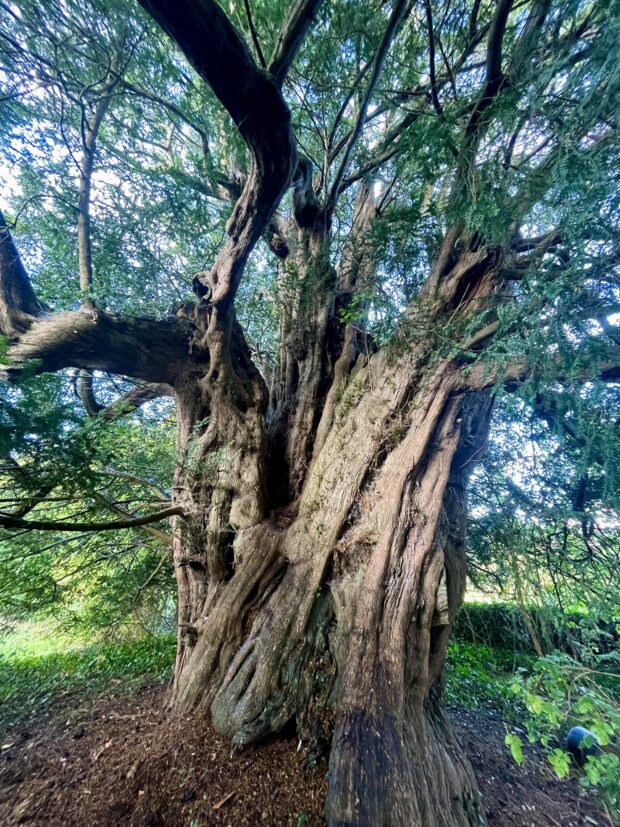
Image: The Longleat Yew (credit: Angus Rankine)
ATF meetings are known for their tendency towards group discussion and debate, and our visit was no exception, a great gathering of tree enthusiasts all keen to share their knowledge and learn from others.
We look forward to the next visit!
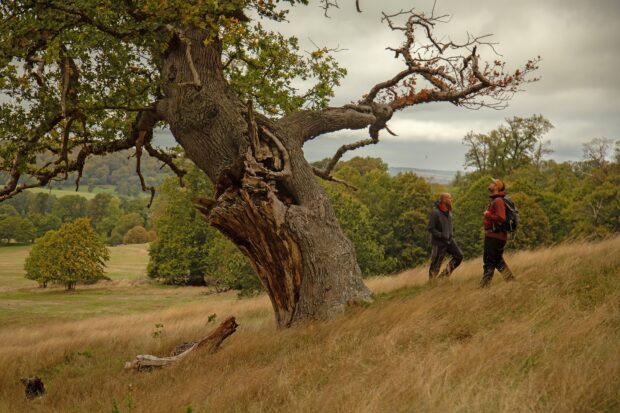
All image credits: Angus Rankine
13th October 2026
ATF Essex Report – Visit to Epping Forest; 26 Sept 2026
By Steve Woodley (ATF Essex)
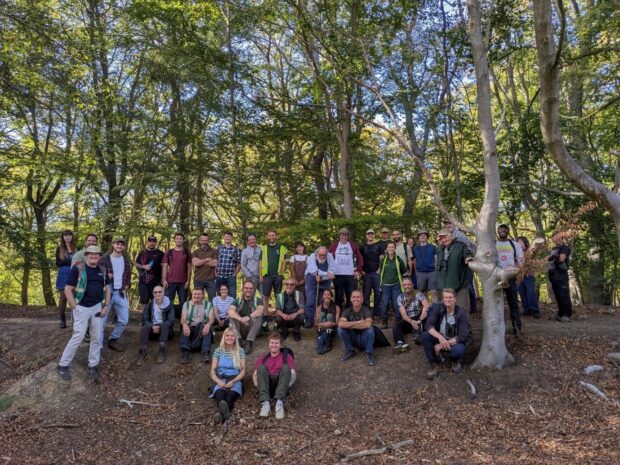
Image: Steve Woodley
Today was a special day. It brought together both the Ancient Tree Forum (ATF) and the staff from Epping Forest.
The day began with an opening address from the ATF team who then handed over to the Epping Forest staff to guide the walk, and what a walk it turned out to be.
Almost as a warm up for what was to come, we stopped at our first Beech tree. Growing together with a now dead Oak it gave the group the chance to start discussing various topics including why veteran trees are important and how dead trees play an important role in the biodiversity of the woodland. This was to set the scene for the day as question after question came from the assembled audience.
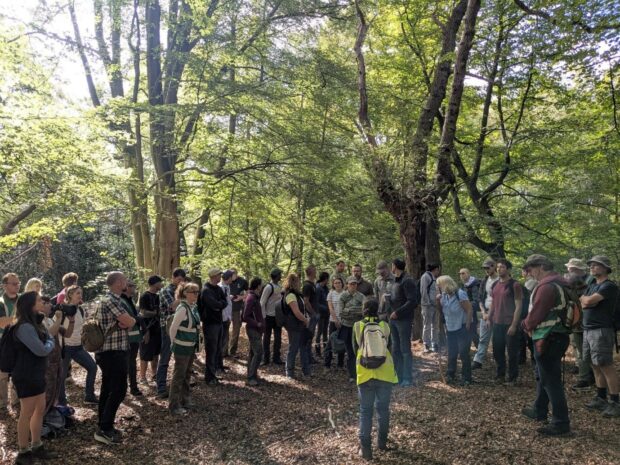
Image: Steve Woodley
A little farther in, down one of the main rides we came to the first main stop of the day, a truly magical copse of mostly Beech pollards with a scattering of maidens. The Epping staff used the backdrop of trees to bring to life the history of the area and its cultural significance, its changes of use and the many pressures and difficult decisions the team had to make to maintain its both historical and ecological value. The talk was added value by the team producing large blown up photographs of the area dating all the way back to 1898! The audience was given the chance to try and see if they could spot any of the trees around and match them to the photos.

Image: Robin Hellier
A short walk later and we arrive at the famous site of Ambresbury Banks Iron age hill fort.
The defensive ditch, still clearly visible, covers some 4.5 hectares and was built approximately 700BCE. Now a scheduled ancient monument, it provided the perfect environment to discuss the many complexities the area has. When originally in use the site would have been clear of trees allowing for visibility, now you have a significant population of trees within its footprint. Due to its land classification it should be devoid of any major vegetation to protect the hidden archeology and allow clearer viewing, but in ecological and biodiversity terms returning the area to this condition would have massive impact. The Epping team talked of the different agencies involved and present management of the site and once again, the many factors they have to take into account before any decisions are made. One last thing considered, did Queen Boudica visit there? Maybe.
Situated amongst an area of fallen trees, the next stop was for lunch. Whilst theoretically a break from the days agenda, time and again it proves its worth as people form small groups and discuss various tree related topics.
Lunch is behind us and we arrive at the next area. Not strictly tree related but still entirely relevant to the day, we looked at a recent pond excavation. We considered its impact on the surrounding trees and its overall benefit to the area. Again it was a time for lots of questions and also for considering not only the trees but the landscape from a wider context.
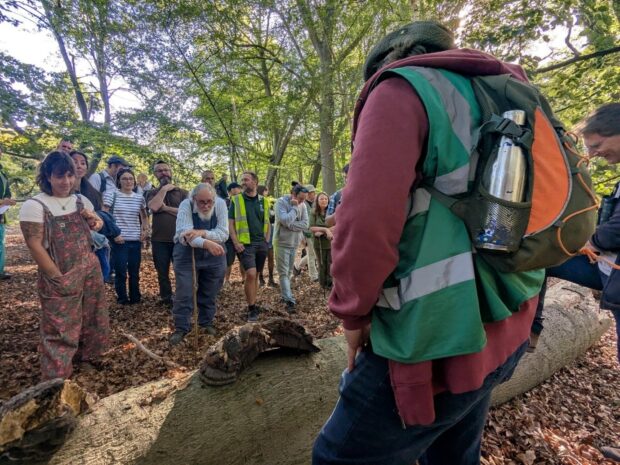
Image: Steve Woodley
Moving on we stopped next at an area of heathland recreation. Whilst home to what is considered the largest concentration of pollarded trees in Europe, some 55000 no less, it also supports diverse habitats. One of the rarer ones being heathland. Again the Epping team talked us through the challenges and subsequent decision making. It was also here that the subject of mechanisation in woodland management came up for discussion with pros and cons being considered.
The last stop was no less interesting, we visited the area where new pollards have been created. A line of young trees that have been pollarded with consideration to the traditional Basque technique still practiced in Spain. The Epping team have made various visits to the region to swap ideas and practices with local people still involved in the practice. The fitting end to the most perfect day.
Whilst I like to think the Essex group of the ATF put on a brilliant day for those interested in the amazing world of trees, this walk was made truly fantastic by the following people from the Epping Team. Tom Boughton, Grant Thornhill, Dr Sally Gadsdon, Dr Jeremy Dagley and Gavin Bodenham.
6th October 2026
Report – National Field Meeting at Newlands Corner and Albury Estate
By Rhiannon Hoy, ATF Associate Board Member
The ATF National Field Meeting on Thursday 24th September 2026 began at Newlands Corner with a morning walk, before heading over to the Albury Estate for a wander through the parklands in the afternoon. Geoff Monck (Arboricultural Consultant at Treecosystems), delivered a fascinating tour of the ancient yews, oaks and sweet chestnuts. He discussed the work which himself and the dearly remembered Neville Fay had put into restoring the soils and trees across the two sites with funding from the Surrey Hills National Landscape.
During our first few stops of the morning Geoff showed the group the ways in which soil compaction from heavy footfall around the yew trees at Newlands Corner had been reduced and diverted with the creation of dead hedges lining the paths and a raised boardwalk allowing visitors to explore the trees up close. Some early signs of success were the regenerating yew seedlings across the woodland floor, which now had the space to grow.
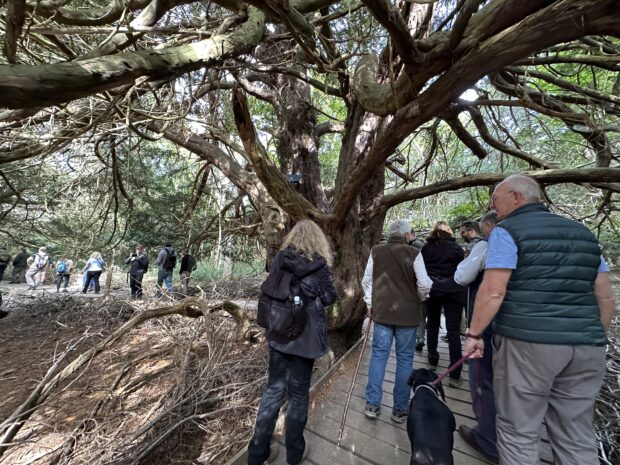
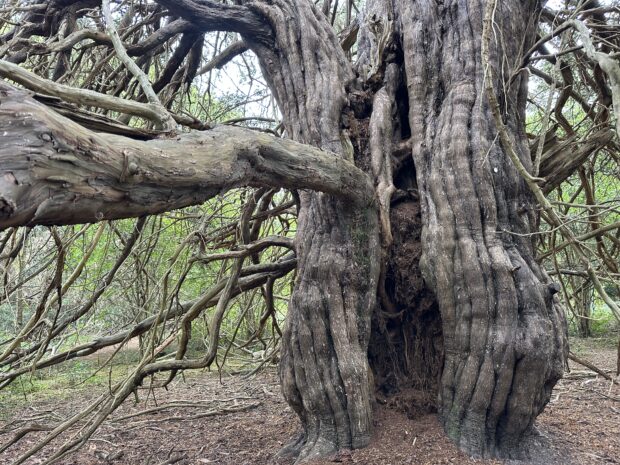
Deeper into the depths of the site, we marvelled at the great size of the yew trees and imagined how they would have looked in the past as part of the historic wood pasture, with grazing livestock underneath and wide spreading canopies. Geoff talked about the interesting technique being used to restore the soils here by vertically mulching within the dripline of the tree to boost the mycorrhizal activity. He explained that they are now seeing positive responses from the yews with some showing new growth on their trunks. On our way out we stopped at a hollowing yew with aerial roots rooting within its own wood soil, incredible!
It wasn’t just yew trees however, Newlands Corner is also home to a magnificent rowan tree which appears to now be several individuals or remnants of the original trunk!
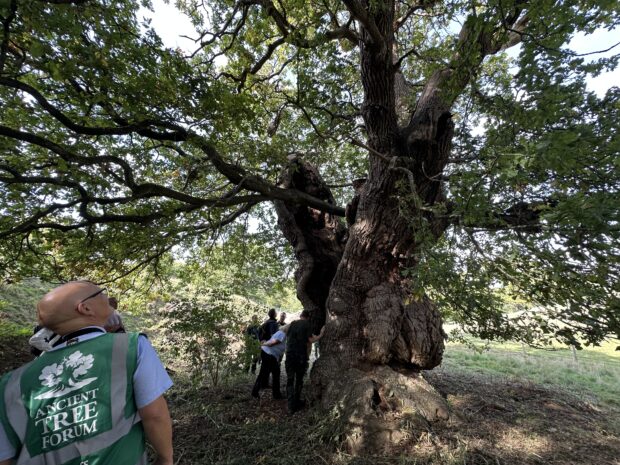
We moved onto the privately owned Albury Estate after lunch where Geoff has been continuing his soil treatments on the parkland oak trees and remarked on the importance of it for saving those which were struggling. The landscape was impressive, with numerous oaks and sweet chestnut trees scattered about, each in various stages of life and with valuable habitat features. The cuckoo silver birch tree bursting from the layered limb of one oak tree was popular with the group.

To end the day, we ogled at a historic attempt to retain a hollowing oak tree with metal chains, now imbedded within the limbs of the oak as well as a piece of farming equipment buried beneath the tree’s own soil inside the hollow. There was a lively conversation around the need for continued bracing of the tree, to do or not to do – the usual question.
An all-round fantastic day filled with knowledge and information sharing between ancient tree enthusiasts. For those that want to visit Newlands Corner and experience the history of the trees for themselves, see the Surrey County Council’s website: Newlands Corner visitor information – Surrey County Council.
All Image Credits: Rhiannon Hoy
17th September 2026
ATF Sussex Report – Visit to Petworth Park
By Bob Epsom, ATF Sussex Coordinator
After having a break in 2025, the ATF Sussex local group held a walk on Saturday 1st of August 2026 at Petworth Park. We were joined by 30 people in glorious weather. This was a return visit to the famous Capability Brown designed landscape, as the group previously visited the southern park in 2023. With such a large population of ancient and veteran trees, a return visit to the north of the parkland was needed.
Tom, the National Trust Ranger for the property, led the walk. Our first stop was a huge 7.75 metre ancient sweet chestnut tree on Monument Hill. The tree has a huge cavity in the trunk, a fallen attached limb that has layered, aerial roots and many other veteran characteristics. It even had the claim from the consultant who surveyed it as the best ancient tree ever seen!
We then continued an upward journey to a large dead oak overlooking the bowl of the park and the greater landscape of the Sussex Weald and Downs beyond. Discussion was had on the tree surveys at Petworth and the management of this designed landscape. Tom explained that there were not many named trees in the park but has, himself, called the next tree “The Barrel Oak”. He mentioned this was also referred to as the same by one of the ecologists working in the park. It is an 8-metre girthed oak with huge burrs all over the trunk. It was pointed out that Petworth has quite a collection of exotic oaks in the gardens and park, with a recent discovery of a sawtooth oak being present. It is easily walked past thinking it is a sweet chestnut, having similar sized and shaped leaves.

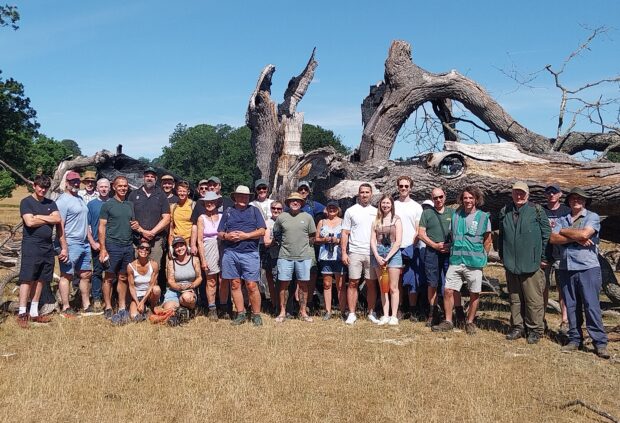
Next up was one of the largest trees of the park, an oak that measured 8.96m that was struck by lightning in 2024. It apparently burned for four weeks. Fortunately, as this tree is in the wider park, away from the path and not in the way of any historic views, it has been left in situation. We then skirted around the edge of the Lower Pond where some of the chestnuts have had dead hedging put around them to help reduce visitor impacts. The last stop was to one of the only named trees in the park, the Beelzebub Oak. It’s marked on the present-day Ordnance Survey map and even has a name plaque on the adjacent perimeter wall. The tree is now dead and there is speculation whether this was a replacement tree, as a tree was noted at this location on a 1779 map.
For those that want to visit this important collection of trees, Petworth is accessible in daylight hours at all times. See the National Trust webpage https://www.nationaltrust.org.uk/visit/sussex/petworth
Tom and his team of volunteers are currently adding all the trees to the Ancient Tree Inventory as the records have previously been quite limited. Once complete, this will provide a useful resource for anyone wanting to explore this magnificent site for old trees.
All Image Credits: Ancient Tree Forum Sussex
10th September 2026
ATF Essex Report – Visit to Chigwell Row Woods
ATF Essex recently visited the wonderful Chigwell Row Woods and discovered a fascinating array of veteran trees and associated fungi. To read the full report by Shane Lanigan and view Shane’s photos of the fantastic fungi and hornbeam pollards they encountered along the way, please click here: Chigwell-Row-Woods-Review.pdf

An Autumn Woodland Wander
With autumn just around the corner, we’re sharing a reminder of how uplifting an autumn wander in the woods can be. Last autumn, ATF Essex visited the wonderful Coombe Woods in the Langdon Hills. To read the report by James Chambers, and view photos of some rather captivating trees and fungi, please click here: Coombe-Woods-Report by James Chambers.pdf

4th September 2026
My Role as ATF Associate Board Member
by Rhiannon Hoy
In December I was thrilled to be appointed as Associate Board Member to the ATF’s Board of Trustees. So far, I have had the pleasure of joining the other Members in the Trust’s Board meetings and have bi-monthly catch-ups with my mentor from the panel, Tom Hill, to discuss my progress with the objectives we set out for my development role.

Image: Rhiannon with an ancient hazel
The objective I have enjoyed most has been to visit flagship sites for ancient trees, with my favourite to date being Savernake Forest in Wiltshire – home to the big belly oak! Day-to-day my role at the Woodland Trust as Outreach Adviser is to support private landowners with ancient woodland restoration and ancient tree protection and management. The two organisations are already known for their great partnership working in the world of ancient trees, but the additional crossovers and support that my Associate role has opened for me has been invaluable.

Image: Rhiannon visiting the Big Belly Oak
At the beginning of my term, I gave a tour at one of our landowner sites in Kent to the ATF’s Director, Bob Warnock, and Trustee, Tom Hill, to discuss the support and advice I’ve offered for managing their precious woods and trees. Soon I will be working closely with a VETcert specialist at the same site to delve deeper into the nuances of managing the historic laid hornbeam hedges, whether that be to leave them alone or to bring them back into a slow and gradual management cycle. I am also a VETcert trainee, so what better way to learn than in practice with trees I already know! My upcoming plans are to continue attending the local ATF group walks and I am looking forward to the next meeting with my fellow Board members to discuss all things ancient trees!
Image credits: Rhiannon Hoy
27th August 2026
ATF Essex Report – Visit to Garnett’s Wood
by James Chambers

Image: giant lime coppice
ATF Essex local recently had another lovely veteran tree walk in an ancient woodland. It was a lovely day for a stroll, sunny, but with the shade under the trees providing a respite from the heat. Garnetts wood is an ancient woodland and SSSI for its coppice trees, including the now rare small leaved lime trees.

Image: James Chambers in the decayed void
The wood is owned and managed by the local authority, who still manage it as a coppice. This gave us the opportunity to see coupes in different stages, some recently cut, others approaching their next harvest. We wandered around viewing multiple different species which had been coppiced for different purposes, as well as ancient wood boundaries and trees cut higher than usual, probably as boundary markers.
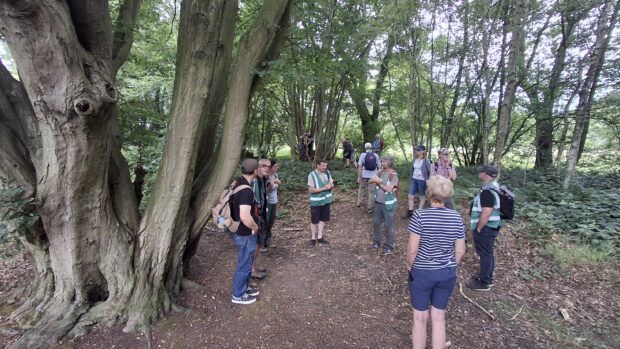
Image: ancient hornbeam coppice
Later we enjoyed a packed lunch in the shade of some ancient trees, before continuing our walk around the boundary of the woods. Other points of interest included fallen trees with possible indications of colonisation by Gymnopus fusipes. And a tree with Gymnopus fusipies fungal fruiting bodies by each buttress root! Would this tree be the next to fail?

Image: fungi on roots
And as a special treat for the finale we tracked through the site to find the mysterious Torminalis glabberima – the wild service tree! An ancient woodland indicator species, once more common but now a rare find. It’s off the beaten track and it was a pleasure to admire it for a while.
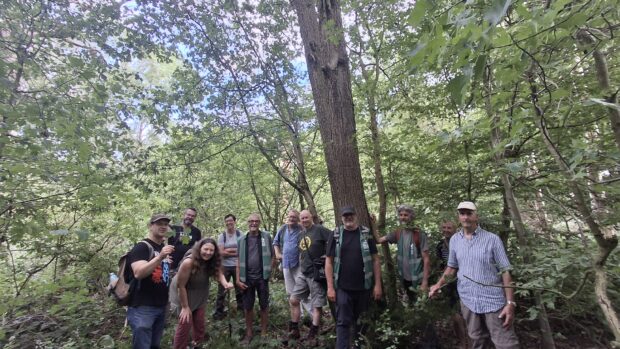
Image: the group with the wild service tree
Thanks as always go to our attendees, with special thanks to the neighbouring farmer who kindly granted us permission to park on their land while in the woods.
ATF Essex will be back for our next walk very soon!
ATF Local Groups – Visit to Blenheim Palace
by James Chambers
A small group of ATF volunteers had a truly wonderful experience visiting the ancient trees of Blenheim Palace in July.
We had a morning of excellent presentations about AoVTs including tree architecture and morphophysiology, some extraordinary hidden ancient apple trees and the lessons we might learn from the misbehaving willow trees that simply refuse to play by the rules!
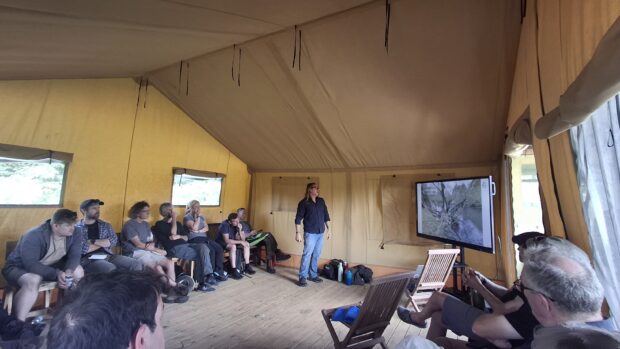
It was a really interesting morning with lots of discussion following each of the presentations. We enjoyed tea, coffee (and delicious biscuits!) thanks to our wonderful hosts, before the second set of presentations.

Richard Powell, the Chair of the ATF, expressed his genuine gratitude to all the ATF staff and also the volunteers who make these walks happen, and share the wonder of AoVTs with anyone who is interested, regardless of their level of knowledge.
Trees are for everyone, and you don’t really need training to enjoy them!
After lunch we had the exciting opportunity of a guided walk among the ancient trees, with our generous hosts Francis Gillio and Filipe Salbany from the foresters team. Their knowledge of the site, leading us from one incredible tree to another, was invaluable!
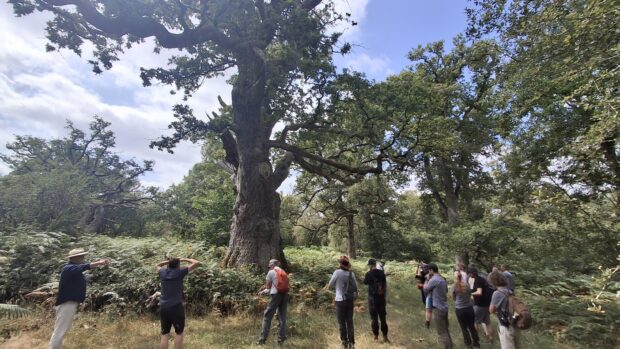
We visited the Kings oak, and later the Queens oak – both in excess of 9m girth! Later we found two of the four trees known to have been colonised by the exceptionally rare Buglossoporus quercinus – oak polypore, (or Fomitopsis pulvina, as it has recently been renamed!) and were lucky enough to find fruiting bodies on two of the trees!
Francis and Filipe were able to tell us about the history of some of the areas, find the biggest trees (5 over 9m girth!)) and even set us up for big surprise reveals by distracting us before trees were visible.
This is a very brief review of an incredibly special day.
Huge thanks to Francis and Filipe for all their kind efforts to make us so welcome and deliver such a memorable and wonderful day.
Image Credits: James Chambers
