


16th October 2026
ATF Kent Report – Visit to Penshurst Estate; 3 Oct 2026
By Richard Arnold (ATF Kent)
Volunteers: Dr Jon Heuch; Rick Vallis; Clive Mayhew; Richard Arnold
Penshurst Estate Hosts: Ben Thomas; Andrew Stronghill
Attendees: 23 total + 3 dogs!
Weather: Warm and sunny
The Penshurst Estate dates from C14th and was owned by Henry VIII at one time, before it passed to the Sydney family, who own it to this day and who very generously allowed us to run this event with the support of their team.
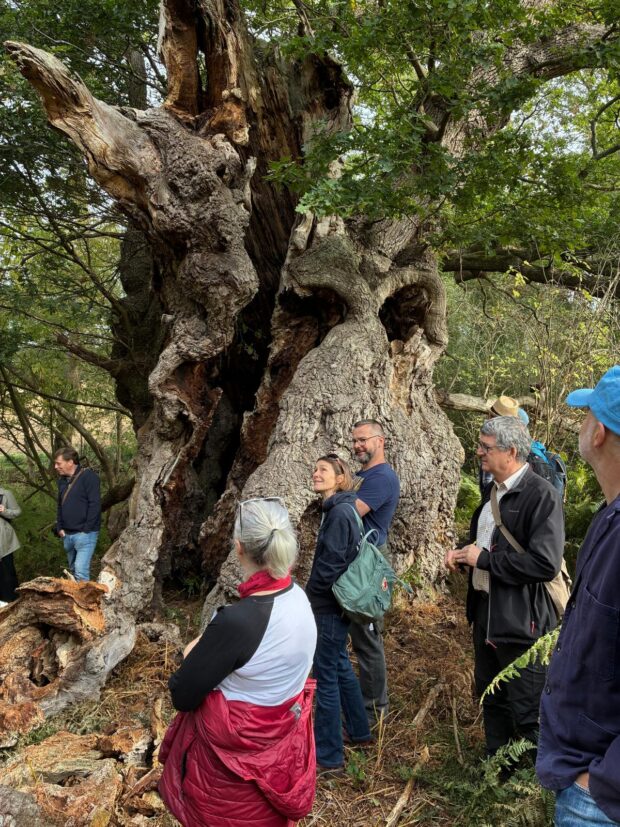
Image: Ancient oak (Quercus robur) at Penshurst Estate (credit: Richard Arnold)
The meeting point was the forestry yard car park at the north end of the estate. This is the private area of the estate, although it is used for bushcraft courses and the like.
First stop was Collinses Tol – an area of veteran / ancient sweet chestnut and beech which had been planted as deer shelter, originally back in the time of Henry VIII. We observed that the chestnuts were dying back (possibly retrenchment in some cases and general decline due to drought stress, compaction and disease in other cases). Despite this, the habitat value was enormous due to the myriad cavities and durability of the timber. Sweet chestnut timber from this area of the park had been used to construct the roof of Barons Hall – the Estates medieval banqueting hall. There was also a great, layering beech tree, complete with decay-nesting hornets!

Image: Layering beech tree (credit: Richard Arnold)
Next we visited a veteran oak tree, which despite being estimated (via Bristol Trees calculator) to be about 400 years old, still had very little decay. We discussed the young beech and holly which was growing up through the crown and some recent(ish) haloing work. A game of ‘pollard, or not-pollard’ was born, as Clive Mayhew debated whether or not it was a worked tree.

Image: Veteran oak (Quercus robur) (credit: Richard Arnold)
The morning then progressed to take in another veteran sweet chestnut before going on to see the veteran silver birch. This was a beautiful tree, complete with historic artefacts! (see photos). There was an unplanned stop adjacent to this tree, where Clive discovered a ‘walking beech tree’ which had collapsed and layered in several directions, giving rise to well-established trees, reminiscent of a spider plant!


Images: Veteran birch at Penshurst Estate (credit: Richard Arnold)
Then came what I think for most of us was the highlight of the day – an ancient oak (Q. robur) which measured 11.8m (@1.5m) – Aljos Farjon had measured it last in 2014 at 11.26m. The Bristol Trees estimate of its age (given the location) was between 1050 and 1498 years. The tree appeared to be thriving in its location and vitality/ condition of the crown was very good. The tree was almost certainly a ‘worked tree’ and Clive thought he had ascertained where a ladder would have been placed and where a worker would have braced themselves to swing an axe. Much discussion of the use of lateral oak beams in ships hulls and the like. We were all reluctant to leave this wonderful ancient behind us!
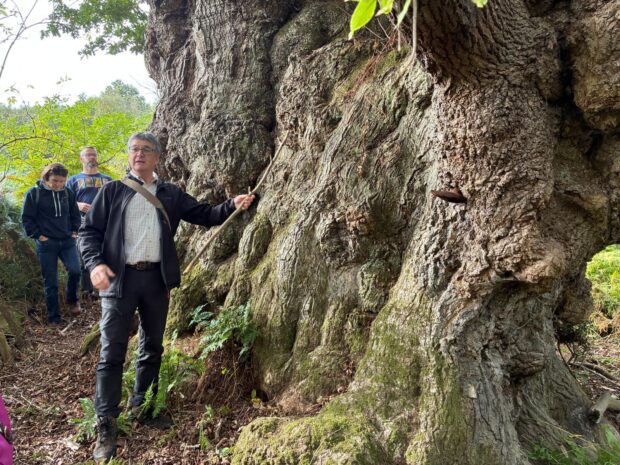
Image: Ancient oak (Quercus robur) (credit: Richard Arnold)
We ended the morning session by comparing two veteran (one arguably ancient) beech trees. The older had clearly been pollarded and was also sporting a profusion of Ganoderma (applanatum) fruiting bodies. There was debate as to whether the younger tree had been worked – which led to Clive speaking about the use of beech in WWII to make plyboard for, amongst other things; Mosquito light-bomber planes!
We re-grouped at the café near the main house for lunch and then into the afternoon session.
We walked north through the old grade I listed parkland to look at a very large uprooted oak, which had apparently had a full crown and appeared to be of good vitality before it fell a few years back. Looping back round, we stopped at the remains of the bolling of the Sydney oak (or Bear oak), which had been over 1000 years old when its last bough finally failed in 2016. One of its progeny grows adjacent (many other seedlings were shipped around the country and the world….

Image: The Sydney Oak (credit: Richard Arnold)
We then entered a tree archaeology phase as we looked at ancient sweet chestnut stumps. Clive Mayhew had brought with him a Gunter’s measuring chain but found that the distance between stumps did not measure at a standard chain length. Reflecting on it, he said that the chestnuts (which were felled in the 1970’s) pre-dated the standardised chain (1620) and were therefore probably laid out using a locally used measuring chain. There was some debate as to whether epiphytes/ cuckoo trees should be allowed to grow within the stumps, or whether the archaeology of the stumps should be preserved for longer by the removal of such pretenders. Clive mused that a building foundation of this age would likely be listed but that a tree stump (even part of a historic avenue) is generally overlooked and rarely protected.

Image: Sweet chestnut stump (credit: Richard Arnold)
From here we visited Barons Hall – the C14th banqueting hall, complete with sweet chestnut roof before heading into the formal gardens to see a Ginkgo growing intimately alongside the house (probably C18th planting) and a veteran (maybe pollarded) sweet chestnut growing intimately adjacent to the garden wall!

Image: Roof at Barons Hall, constructed with sweet chestnut (credit: Richard Arnold)
We finished with tea and cake at the café, kindly sponsored by Rick Vallis (Silva Woodland Mgt), who is the forestry consultant for the estate (and a new volunteer with Kent ATF).

