


10th February 2022
The Ancient Trees on Offa’s Dyke, a blog by Andy Gordon
The Ancient Trees on Offa’s Dyke
It is widely accepted that Offa’s Dyke was built during the reign of King Offa of Mercia (757-796). The dyke roughly followed the current English Welsh border but was not continuous, running in three sections for 81 miles (of the 150 miles) from the Bristol Channel to the Irish Sea. It had a ditch on the Welsh side, with the displaced soil piled into a bank on the Mercian side. No trees would have been planted on the dyke itself at the time of construction, and there are no records of trees having been planted at any time. Over the last 23 years, the position of 441 trees, 38 different species, have been recorded on the Ancient Tree Inventory (ATI).
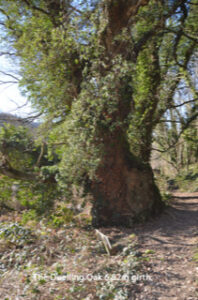
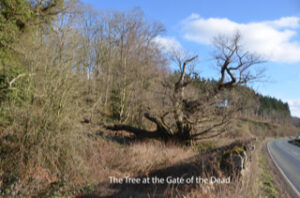
The oldest tree, and one of the earliest trees added to the ATI is the Pedunculate oak known as The Tree at the Gate of the Dead, on the southern edge of the Chirk Castle Estate. Until 2012 when it split in two, it measured 9.53m in girth, suggesting an age of about 1000 years. Records show that the “Dead” in the name refers to the soldiers of King Henry II who were ambushed here by Prince Owain Gwynedd.
By tracing the route of the dyke itself, not the Offa’s Dyke path which deviates significantly at times, it has been possible to identify a total of 441 ATI recorded trees, either on the dyke or within 5m of its track. Not surprisingly 211 trees (48%) are oaks. With 135 named as “oak”, 51 identified are pedunculate, and 15 as sessile. Another 35 oaks along the dyke have girths in excess of 5m, suggesting ages of over 300 years.
Beech is the next most numerous species (10%), with two trees with girths over 8.5m in the woods to the east of the Wye near Whitebrook. Ash (8%) is also abundant, with the largest a massive multi-stem tree measing 8.4m in girth at 50cm.
There are 25 yews (6%) recorded in the ATI, the largest and possibly the oldest, has a girth of 4.32m, probably around 700 years old. Although a maiden, it has significant fluting which makes ageing it difficult.
Limes (also 6%) are only once specified. Five percent of the trees are Scots Pine. Species appearing less than 5%, are Hawthorn (3%), unspecified birch (3%), field maple (2%), hazel coppice (2%) with some having been left uncut for many years, rowan (2%), and cherry (2%). Sycamore (1%), apple (1%), other conifers (1%), willow (1%), elder (1%), holly (1%) and sweet chestnut (1%), and individual trees of hornbeam, English elm, horse chestnut and alder are also present.
These records, as with other ATI entries, maybe influenced by a recorder’s interest, location, and site accessibility[1]. As a result, many ancient and veteran trees in the UK have not yet been recorded; could still be waiting to be found on Offa’s Dyke!
Andy Gordon
[1] Nolan, Victoria; Reader, Tom; Gilbert, Francis; Atkinson, Nick. 2020 The Ancient Tree Inventory: a summary of the results of a 15 year citizen science project recording ancient, veteran and notable trees across the UK. file:///C:/Users/JanieBurrage/Downloads/The_Ancient_Tree_Inventory_a_summary_of_the_result.pdf [Accessed 08.02.22].
13th December 2020
A wooded landscape delivering the benefits, but due for the chop!! A blog from Ian Rotherham.

Jay (photo credit: Ian Rotherham)
I imagine that if I said there was an area of urban-fringe countryside which delivered the following, you would expect its future to be safe, secure, and even celebrated:
- UK Biodiversity targets – a local biodiversity hotspot for birds, badgers and other mammals, and for invertebrates such as butterflies, bumblebees, hoverflies, and more…
- Floodwater mitigation and sustainable drainage targets – holding back the flow to sustain local watercourses and contributing to reducing flood-risk downstream
- Climate-change mitigation targets – the site is actively sequestrating carbon from the atmosphere to reduce greenhouse gas impacts – and this landscape provides resilience to adverse changes
- Health and wellbeing benefits to local people – the site surrounds a local health centre and is much loved and well-used by local citizens – it supports people’s mental and physical wellbeing – and important during COVID, has been freely available during LOCKDOWN
- Conservation targets and includes supposedly protected ancient woodland
- The ‘government’s Future Treescapes Strategy’ through safeguarding existing ancient woodland and through a spontaneous (natural) new woodland which has self-set on former farmland abandoned thirty years ago. This is now a dynamic and incredibly exciting habitat with diverse tree species, orchid-rich grassland, and extensive bramble scrub providing rich shelter and feeding for birds like bullfinches and long-tailed tits, for a wide range of butterflies, and yes, badgers, foxes and roe deer. Above all though, it is growing a huge number of new trees for the future. It is quite literally, buzzing with nature…..
- It is helping to address Sheffield City Council’s stated aim to deal with the ‘climate change crisis’ and the climate emergency….
28th September 2020
CEO Update – September 2020

Autumn beech at Dyrham Park (photo credit: Brian Muelaner)
An update and an invitation from the CEO
Help us shape the ATF’s future – 175 of you responded to our recent survey about what ancient and other veteran trees need over the next five years – showing us how many of you care and are knowledgeable about ancient and other veteran trees.
You’re now invited to shape the role that the ATF can play in their future by coming to an online workshop on one of the following mornings: 12th, 13th or 14th October – between 10am & 1pm. At this workshop, we will build upon the findings from the recent survey, and ask you to input to the opportunities for the ATF to take in the future.
We’re looking to involve around 30 people in total, so if you can attend and are interested, please email admin@ancienttreeforum.co.uk by Tuesday 6th October with the dates you’re available and also – we particularly welcome you if you’re from an ATF local group, a previous member of an ATF working group, one of the ATF’s partner organisations, or if you personally have a diverse background of any kind (see our diversity policy here). Please state in your email the date(s) you are available and if you have one of these roles/backgrounds.
Republishing the Ancient Tree Guides – We’re working with the Woodland Trust and refreshing and republishing our jointly owned Ancient Tree Guides – involving our very own expert volunteers and also a number of partner organisations from the Arboricultural Association, the National Trust, the Gardens Trust, Lowther Estates, the National Farmers Union and the Soil Association.

Goodbye, and thank you to Jim Mulholland – After four years of working at the Ancient Tree Forum, Jim Mullholland left the post of training and technical officer at the end of August to pursue personal projects of a campervan variety. Jim helped deliver projects such as VETcert and the City of London self-guided trails and oversaw the curation of the Summer Fora. The team and trustees gave him a send-off with many current and past colleagues able to attend the zoom “party” from all over the country, with tea, cake, funny stories of the past and well-wishes for the future. Jim will still be in touch with the ATF through his continued work at the Arboricultural Association, particularly on VETcert. And I’m pleased that Jim will still remain involved in the ATF in other capacities, primarily as a trainer. This is building on the ATF’s positive relationship with other, previous team members, who are also still involved in the organisation.
England Tree Strategy – the ATF’s response
The Ancient Tree Forum submitted its response to this government consultation after collaborating with two groups:
- Our volunteers – we invited a number of our close volunteer experts to write the ATF’s detailed response with us – and we’d like to thank them for their time. You can see the ATF’s official response here.
- Also, we took the main points of our own response above and contributed them to a wider response which was sent direct to Lord Goldsmith, by working as part a coalition of environmental charities convened by the Tree Council. This coalition put together a list of recommendations that should form the basis of the England Tree Strategy – called the “golden thread” – you can see this joint response here.
Laura Alcock-Ferguson, CEO, Ancient Tree Forum
Email: CEO@ancienttreeforum.co.uk
Twitter: @LAlcockFerguson
15th August 2020
Recognising …. open grown trees

Picture a tree in a woodland
What does it look like? I am going to guess that you are picturing a tall tree, with very few branches until the top canopy where it reaches the light.
Now picture a tree in a field
I bet the tree you are picturing has branches lower down the trunk, it has a full billowing crown, and maybe, just maybe, a thicker trunk.
If I was right, your imagination has already shown you many of the differences between trees grown at high density and those grown in open habitats. Good work!
10th August 2020
The Preston twins – and then there was one….

The Preston Twins – and then there was one…
Preston Park, Brighton, East Sussex
As an ATF team, we have been framing our work within the themes of Recognise, Protect, Restore and Enhance. Julian Hight’s blog post below is about the iconic Preston Twin elms in Brighton, recognising their cultural and ecological heritage, and how and why their very survival has been significant. Julian also touches on the measures taken to attempt to protect the trees structurally and from Dutch Elm Disease.
20th July 2020
ATF Spring field visit to Stanway and launch of ATF Gloucestershire

Lake at Stanway & sweet chestnut (photo credit: David Clayden)
As I ponder and reflect back on this event, to find the words and order them in a manner which allows those who did not partake in the day to reconcile my narrative with the photos and feel they were ‘there’, I can’t help but sense a large elephant in the room – COVID-19. In the organisational stage, Coronavirus was a topical feature of the distant world news, with no greater perceived threat to the UK shire counties than indeed, an elephant – oh, how that changed. On the day itself, there was some jovial elbow bumping rather than handshaking, seemingly in jest with no one really having any idea of how rapidly all of our lives would change, nor the severity of the situation soon to be upon us. I am thankful that, by only a few days, the visit fell on the right side of movement restrictions and went ahead. I hope everyone reading this is well, and of course urge everyone to take the necessary precautions to continue staying safe, but for the purpose of this article, lets move on to trees.
13th July 2020
CEO Update – July 2020

Knepp cows (photo courtesy of Knepp Castle Estate)
CEO Update – July 2020
With Covid-19, it has been an incredibly busy year so far. The following are highlights and special updates of work undertaken since March.
Local groups – we have worked hard to keep them engaged and supported during the last three months with two Zoom meetings in the absence of an annual network day this year. During these Zoom meetings, Clare, our partnerships consultant, Jim, our training and technical officer and myself as CEO, as well as Russell, our Chair, discussed with local groups:
- Co-producing a Covid-19 risk assessment for local group events (which will not be implemented until government guidance changes to allow this, but is now ready to go);
- Diversity, equality and inclusion – asking their views about what they would like to see the ATF do;
- How they wish to continue to work alongside and be supported by the ATF – this was already planned as part of the EFF2 grant, and is also feeding into the next stage of the strategic review.
Many of our local groups’ volunteers are juggling jobs, childcare and managing ongoing personal and professional changes as a result of coronavirus, so we were happy to have 15 people on the first call. They were keen to input, retained their enthusiasm for their volunteer roles, and were sensible and supportive about the ATF Covid-19 response and its plans for the future. We’ve also been keeping contact with two prospective new groups: Northwest and Northeast England, and the new group, Wales (South and West).
30th May 2020
A New Strategy for New Times

ATF at Minterne (photo credit: Brian Muelaner)
A new strategy for new times
The ATF has seen lots of change over the past few years, with a new Chair and trustees, major successes and growth – with new partnerships, new local groups, and new training courses, as well the usual “sold-out” events and policy wins.
Building on those successes and also acknowledging the potential within and for the organisation, I was invited to become the first CEO of the ATF last year. It was made very clear at interview stage, last March, that I would be asked to prepare the organisation for its next steps. And on joining I knew that the strengths of the ATF are in the people – and so many of you are keen to do more, to give your expertise and time. And I know that the team can harness this support and expertise with even more co-ordination and effort. But to do that well, we need to get organised.
In short, we need a strategy. So, one of my major endeavours this year is to involve as many of you as possible in sharing and shaping ideas to build a picture of what the ATF’s future will look like.
21st May 2020
The Ancient Tree Forum Podcast

The Ancient Tree Forum launches its podcast series.
Stay up to date with goings-on in the world of ancient and other veteran trees as we talk to the experts.
In episode 1 Luke Steer talks to host Clare de Villanueva about tree planting targets, pollarding, ash dieback and wood pasture. What does Luke think about the numbers the UK are looking to plant, and where should we plant them? How is ash die back developing in Cumbria? What makes wood pasture interesting? Find out this and more by listening below.
