


10th February 2022
The Ancient Trees on Offa’s Dyke, a blog by Andy Gordon
The Ancient Trees on Offa’s Dyke
It is widely accepted that Offa’s Dyke was built during the reign of King Offa of Mercia (757-796). The dyke roughly followed the current English Welsh border but was not continuous, running in three sections for 81 miles (of the 150 miles) from the Bristol Channel to the Irish Sea. It had a ditch on the Welsh side, with the displaced soil piled into a bank on the Mercian side. No trees would have been planted on the dyke itself at the time of construction, and there are no records of trees having been planted at any time. Over the last 23 years, the position of 441 trees, 38 different species, have been recorded on the Ancient Tree Inventory (ATI).
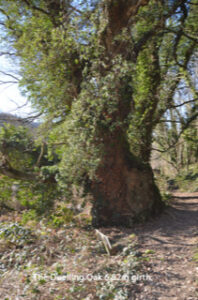
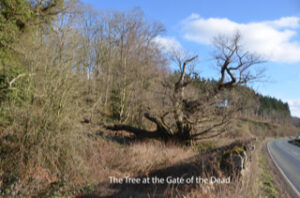
The oldest tree, and one of the earliest trees added to the ATI is the Pedunculate oak known as The Tree at the Gate of the Dead, on the southern edge of the Chirk Castle Estate. Until 2012 when it split in two, it measured 9.53m in girth, suggesting an age of about 1000 years. Records show that the “Dead” in the name refers to the soldiers of King Henry II who were ambushed here by Prince Owain Gwynedd.
By tracing the route of the dyke itself, not the Offa’s Dyke path which deviates significantly at times, it has been possible to identify a total of 441 ATI recorded trees, either on the dyke or within 5m of its track. Not surprisingly 211 trees (48%) are oaks. With 135 named as “oak”, 51 identified are pedunculate, and 15 as sessile. Another 35 oaks along the dyke have girths in excess of 5m, suggesting ages of over 300 years.
Beech is the next most numerous species (10%), with two trees with girths over 8.5m in the woods to the east of the Wye near Whitebrook. Ash (8%) is also abundant, with the largest a massive multi-stem tree measing 8.4m in girth at 50cm.
There are 25 yews (6%) recorded in the ATI, the largest and possibly the oldest, has a girth of 4.32m, probably around 700 years old. Although a maiden, it has significant fluting which makes ageing it difficult.
Limes (also 6%) are only once specified. Five percent of the trees are Scots Pine. Species appearing less than 5%, are Hawthorn (3%), unspecified birch (3%), field maple (2%), hazel coppice (2%) with some having been left uncut for many years, rowan (2%), and cherry (2%). Sycamore (1%), apple (1%), other conifers (1%), willow (1%), elder (1%), holly (1%) and sweet chestnut (1%), and individual trees of hornbeam, English elm, horse chestnut and alder are also present.
These records, as with other ATI entries, maybe influenced by a recorder’s interest, location, and site accessibility[1]. As a result, many ancient and veteran trees in the UK have not yet been recorded; could still be waiting to be found on Offa’s Dyke!
Andy Gordon
[1] Nolan, Victoria; Reader, Tom; Gilbert, Francis; Atkinson, Nick. 2020 The Ancient Tree Inventory: a summary of the results of a 15 year citizen science project recording ancient, veteran and notable trees across the UK. file:///C:/Users/JanieBurrage/Downloads/The_Ancient_Tree_Inventory_a_summary_of_the_result.pdf [Accessed 08.02.22].

