


1st November 2022
ATF Field trip to County Hall and the Kenn Church Yew
ATF Field trip to County Hall and the Kenn Church Yew.
The weather was kind, and we had good attendance on the day. We looked at a range of Veteran Quercus x hispanica ‘Lucombeana’ or Lucombe Oaks as many phenotypes and a few different varieties exist today at County Hall. The recent history of this Quercus species was shared with the group, and we saw a few other gems. Including a Beautiful Fagus sylvatica ‘pendula’ or weeping Beech, a Pseudolarix amabilis or Golden larch, a Quercus canariensis or Algerian Oak and a Tetradium or Bee Bee tree and a Genista aetnensis or Mount Etna tree broom.
The neighbouring property, the Veitch families Otago house sits next door and some of their original trees still exist from the nursery and family home. According to Henry Girling the Lucombe, Pince and companies’ original nursery was at County Hall, plus a second site a mile away that later became Pince’s gardens. This explains the non-grafted original Lucombe at the County Hall site. Aran Kimberly kindly carried out a picus on one of the Lucombe’s and shared his findings and we are very grateful to you for the effort in making the day so insightful and special.
The Magic Tree references the Lucombe’s being a cross of Quercus cerris, Turkey Oak and Quercus Suber, Cork Oak and described as “some of the original reached about 35 ft (10m) in 11 years with straight trunks and corrugated bark. This is Lucombe’s Oak. It grows to about 100ft (30m) with spreading branches upswept at the ends and thick saddle like bases. The leaves last well into spring, unless the weather is very severe. The timber is fine and close-grained, pale yellowish-brown and might be a valuable fast-growing hardwood, were it not for its uneconomic propagation.”
The magic tree goes on to state “Seedlings grown from the original clone by William Lucombe’s son in 1792 showed considerable variations in vigour, evergreeness and shape and in the corkiness of the bark. The resulting trees have been often distributed erroneously, under the name Lucombe Oak.”
“The following are seedlings of the Lucombe Oak, raised at Lucombe’s Exeter nursery”
“Crispa called the ‘new Lucombe Oak’ was raised in 1792 by the younger William Lucombe. The bark is corky and the dark green leaves are whitish underneath, with rather crispy edges”
“Dentata raised in 1830 by Lucombe, Pince and company has a corkier bark than its parent. It has large evergreen leaves”
“Heterophylla has leaves of different shapes, the middle of some is reduced to a strip ¼ inch (6mm) wide. It was raised about 1830 by Lucombe, Pince and Co.”
“Suberosa raised in 1792 has 2 inch (5cm) thick corky bark, and small leaves. The original tree, at the entrance to St Thomas nursery was cut down in 1903. The tree by the Chapel at Killerton is probably Suberosa”
References taken from: The Magic Tree- Devon Garden Plants: History and Conservation. National Council for the Conservation of Plants and Gardens (Devon Group) 1989. Devon Books, Exeter.
Larkbeare house was added on the day, a wedding venue for DCC. Home to a large Ancient, Castanea sativa or sweet Chestnut, a massive veteran Sequoiadendron giganteum and a beautiful veteran Tilia x europaea or common Lime and a young Quercus x turnerii or Turner Oak.
The day concluded at Kenn Church at the venerable Ancient Taxus baccata or Yew. This Breathtakingly, Beautiful tree is thought to be in the region of 2000 years old and it was agreed by the group to be at least 1500 years old and measured on the day, just shy of 11 metres circumference. A second Yew of this size class and status exists just 4 miles away at Mamhead church. Something for another day!!! Thank you to all who attended and especially Chris Knapman for his vast and valuable knowledge which he openly shares with all and for supplying the amazing photos, a masterclass talk on the incredible giant puffball, Calvatia gigantea with a delicious example shown on the day.
We had some great debates and few laughs along the way. Thank you so much to the core Devon ATF group, our Chair Mat Shute and to all the members who support the events and for making our day and group such a success.
Bob Stevenson Devon Tree Officer
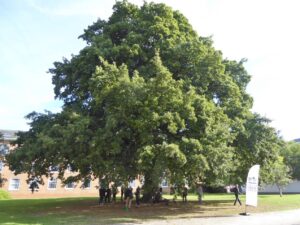
Quercus x hispanica ‘Lucombeana’ Chris Knapman
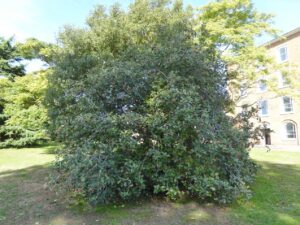
Sorbus devoniensis, Chris Knapman
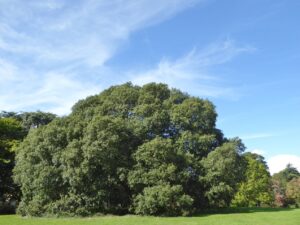
Quercus x hispanica ‘Lucombeana’ Chris Knapman
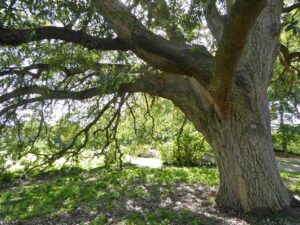
Quercus x hispanica ‘Lucombeana’ Chris Knapman
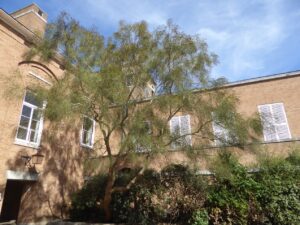
Genista aetnensis Mount Etna Broom Chris Knapman
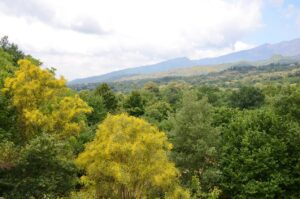
Genista aetnensis Mount Etna Broom Chris Knapman Mount Etna Broom in flower Sicily, Italy.
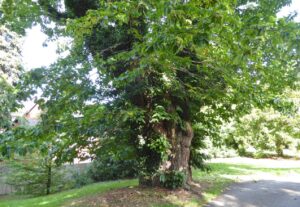
Castanea sativa Chris Knapman
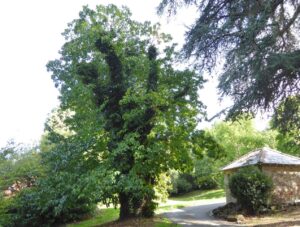
Castanea sativa Chris Knapman
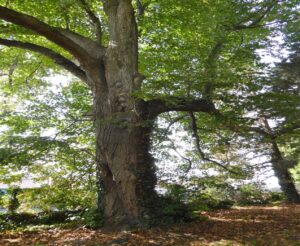
Tilia x europaea Chris Knapman
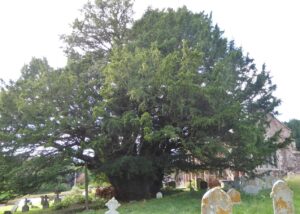
Taxus baccata Chris Knapman
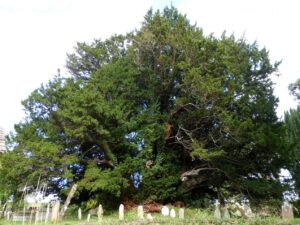
Taxus baccata Chris Knapman
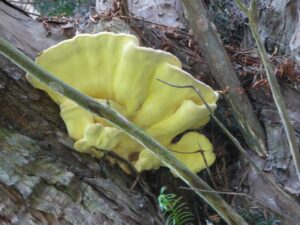
Laetiporus sulphureus on Taxus baccata Chris Knapman
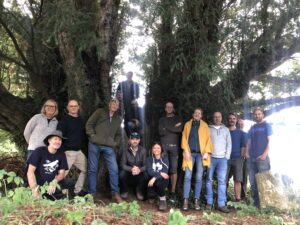
ATF Devon Group


David Cann says:
Posted November 24, 2022 at 2:13 am
Interesting that a picture of Sorbus devoniensis is included, is it at County Hall? Are there any close up pictures of this particular individual?
Bob Stevenson says:
Posted January 17, 2023 at 4:47 pm
Hi David Cann, yes, the Sorbus is at County hall. The site is open to the public and you are free to take a look at anytime. They are naturalised near Teignmouth and Roborough downs. Please contact me at Bob.Stevenson@devon.gov.uk and i will be very happy to supply you with more close up shots and the exact location details of the naturalised Sorbus devoniensis, i have mentioned above. Thank you Bob