


24th May 2023
Herefordshire ATF Local Group: Field Trip to Eastnor Deer Park 22nd April 2023
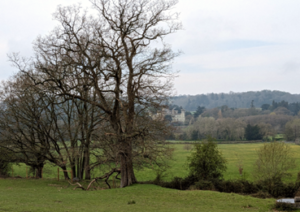
A view across the park towards Eastnor Castle
Image Credit: Jerry Ross 2023
The Herefordshire Branch’s second field trip this year was to Eastnor Deer Park, a tract of land in the south west of the county of about 2km by 2km. The park’s origins probably go back to medieval times, parts having formerly being part of the larger area of parkland associated with Bronsil Castle, 2km east of Eastnor, created c 1460 by Richard Beauchamp but the deer park in its present form was created some time in the late 18th century, while between 1810 and 1824 the then owner, the 2nd Baron (Lord) Somers had Eastnor Castle constructed on land across the road, to the south of the deer park.
Through the 18th century and into the 19th the pre-existing parkland trees had been supplemented by additional planting of individuals and clumps of tree with the intention of creating a ‘landscape park’ as idealised at that time. However, by the 20th century the fortunes of the Somers family had declined and the parkland was left largely to its own devices, until Elizabeth Somers Cock and Benjamin Hervey Bathurst took charge of the estate in 1949 when they began the process of restoring the castle and grounds to their former glory. This process has been continued by their son, James Hervey Bathurst, by whose kind permission we were granted access into that part of the deer park normally closed to the public.
Our guide to the site was Brian Jones, the ATI verifier who has assessed many of the 435 trees listed across the Eastnor Estate (a number that excludes trees within Eastnor Castle Arboretum where others are listed separately). Even within the car park where we gathered there were trees that were not without interest: a couple of mature oaks had recently been felled and within the felled stump of one we found a fungal bracket, identified by Russell Miller as Perenniporia fraxinea. Its common name is the Giant Ash Bracket and, while it is not wholly confined to Fraxinus, it was unusual to find it growing on oak.
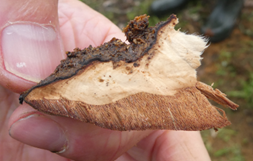
Perenniporia fraxinea showing the characteristically contrasting colours and texture of the flesh and the tubes.
Image Credit: Russell Miller
Russell also pointed out in a felled section of the tree the abandoned galleries of tree ants which, despite no insects being present, he tentatively identified as having been created by Brown Tree ants (Lasius brunneus) or Jet ants (Lasius fuliginosus), both of which are usually found nesting in the rotting wood of trees and stumps.
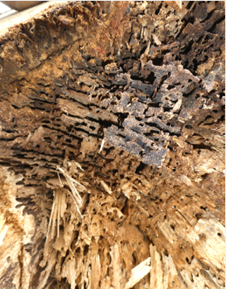
Image Credit: Russell Miller
However, within the park itself there was no shortage of interesting specimens, one of the first being a substantial oak tree, recorded by Owen Johnson as ATI no. 42888. When it was recorded in 2015 it had a girth of 6.2m and was described it as having a ‘hollowing trunk and hollowing branches’. The tree is not within the closed deer park and it is quite close to a major footpath, much used by dog-walkers and others. No doubt for this reason the tree had been reduced quite heavily, with nearly all of its main branches having been cut back. This prompted some discussion as to whether this was the most appropriate form of management. The tree evidently retains very good vigour as notwithstanding the severity of its cut-back it produced dense regrowth from around all of the pruning points. In fact, comparing Owen’s photo from October 2015 with one taken in April 2023, albeit from the opposite side, it seems clear that it has been subject to further cut back, no doubt to control what was seen as excessive shoot growth at the branch-ends.
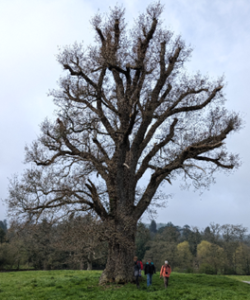
| Tree 4288, in October 2015
Image Credit: Owen Johnson |
Tree 4288 in April 2023
Image Credit: Jerry Ross |
It was suggested that less aggressive crown reduction involving cutting branches back to suitable forks rather than ‘lopping’ them might have resulted in effectively reducing wind loading without stimulating the vigorous regrowth that seems to have resulted in the need to carry out further pruning after just a few years.
At the time of our visit there were only relatively few visitors, but Eastnor hosts numerous events throughout the summer months that help to finance the upkeep of the estate. Thus, the deer park is used for music and other festivals with significant areas used for camping and for caravans. Within these areas, tree safety must therefore be a high priority, a fact that no doubt explains some of what appeared as the rather drastic pruning that had been carried out on a number of trees. However, within the deer park proper, public access is restricted and risk levels (i.e. the probability that a tree failure might result in harm to person or property) are much reduced.
It was encouraging to see that some large debris from fallen or felled trees and from pruning events had been left to provide habitat for saproxylic organisms including one large collapsed oak that to expose cubical rot, probably caused by Laetiporus sulphureus (Sulphur Polypore).
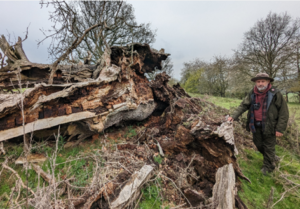
Image Credit: Jerry Ross
This provided rich pickings, including the galleries of the Lesser Stag beetle (Dorcus parallelipipedus). Elsewhere Russell’s knowledge of entomology helped to confirm the biodiversity value of these old trees by identifying the Hawthorn Jewel Beetle (Agrilus sinuatus) as well as the exit holes of Death Watch beetle (Xestobium rufovillosum) and Fan-Bearing Wood Borer (Ptilinus pectinicornis).
Further on we came across a tree one half of whose trunk was dead and had clearly been so for some time. It was conjectured that this may have been the result of lightning, but it was the curiously hairy larva of Ctesias serra that was of particular interest. This is the Cobweb Beetle, so called because its larvae make a living by stealing the remains of dead insects from spider webs. This is a risky procedure and to prevent themselves from becoming food for the spiders whose larders they raid, when threatened the larva erects and vibrates the long bristles that covers its body, the spiders being unable to get their fangs through all those hairs! They are one of the species dependent on old and veteran trees, typically living under the loose bark of old and veteran trees. This one was hiding amongst the crevices of the exposed dry timber but despite being no more than a few millimetres long, it was spotted and photographed by Russell.
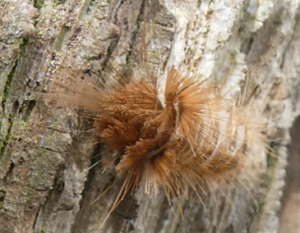

The cobweb beetle larva, and the queue to observe it!
Image Credit: Russell Miller
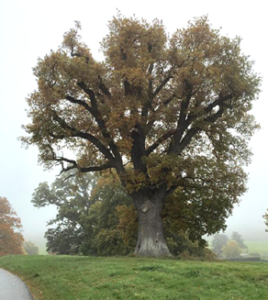
After retiring back to the car park, where the conveniently located Woodshed Café was available to provide drinks, snacks and cakes, a longish walk away from the deer park to another part of the estate took us to a particularly fine ancient oak, well over 8 metres in girth: a good climax to a good day!
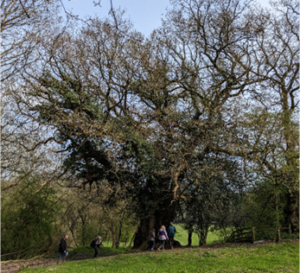
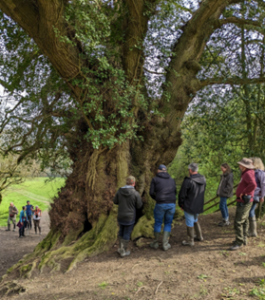
Pedunculate Oak, ATI no. 42884
Image Credit: Jerry Ross
Our thanks go to Mr Hervey-Bathurst for facilitating our visit and also to Graeme Ker, the Resident Agent for the estate, for his assistance.
Jerry Ross
Herefordshire ATF

