


23rd July 2024
Devon ATF Local Group: field trip to Horner Wood – 5th April 2024
ATF Devon Local Group – Horner Wood Field Meeting 5th April 2024
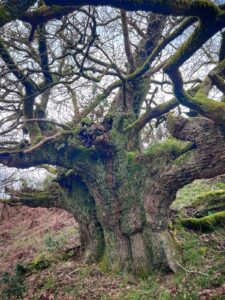
The General
Image Credit: Cheryl Silvawood
In April 2024, the Devon Ancient Tree Forum Local Group set off on a guided walk to visit Horner Wood on the north Somerset coast. Facilitated by Jon Burgess (Forestry Commission Woodland Resilience Officer) – as well as a full team of National Trust Rangers including Rob Manicom (Area Ranger) and Aislinn Mottahedin-Fardo – the Devon group was also boosted by the presence and knowledge of Jill Butler (Ancient tree, forest and wood pasture specialist), Rupert Baker (Chair of RFS Southwest), Julian Hight (Author and heritage tree specialist), amongst other industry consultants and tree afficionados.
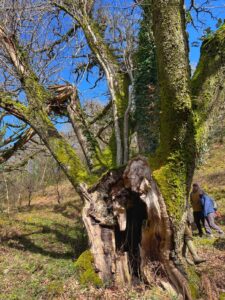
Oak with Rowan cuckoo
Image Credit: Cheryl Silvawood
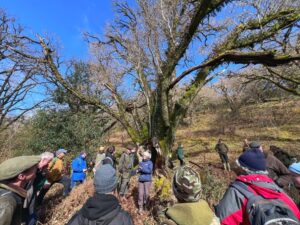
Jill Butler discussing cuckoo tree
Image Credit: Cheryl Silvawood
The group hadn’t moved far from its starting point as talk began around a couple of fantastic lapsed pollarded ancient oak trees – featuring impressive splits and hollows – with one oak in particular hosting a cuckoo rowan growing out from the middle of the oak. Jill Butler suggested the idea that a cuckoo tree could possibly compromise the growth and natural life cycle of its host tree, which then prompted discussions drawing to a consensus that the tree should continue to be observed for overshading by surrounding trees, as well as external conditions that could affect the integrity of the tree, i.e. trunk splits which could provide an opportunity for epicormic growth. The amount of response wood also needs to be observed over time, and as long as there is good growth in the lower canopy of the tree this is a process to be understood before intervening. Jon Burgess emphasised that the oak needed to be kept in full light to allow epicormic growth to be expressed while considering the functional units of the host tree itself, being mindful that there could be a catastrophic loss or failure in the event of a storm.
It is clear that Horner Wood’s pollards are rare and immensely valuable due to the location, quality, age and structure.
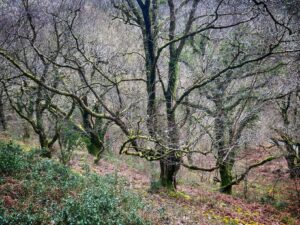
Horner Wood Pollards
Image Credit: Cheryl Silvawood
There was also a good example of a tree that had responded strongly to pollarding work carried out over 30 years ago, juxtaposed with another that had died. Generally, there is a high failure rate with pollarding larger veteran trees; thus managing surrounding external conditions like overshading instead would be a priority. VETcert Consultant Mat Shute, who has worked extensively on veteran tree management with Reg Harris, also spoke about the commitment and high costs to starting new pollards and that it is beneficial to phase cut and leave some original foliage that are more mildew-proof (Jamie Simpson technique), while keeping the tree’s vascular system going and retaining old growth while encouraging new growth. The key is instigating the right management early at the right age and unfortunately with Horner Wood’s tree structure, old lapsed pollards that are gone are possibly never going to be pollarded again but rather, managed as a habitat.
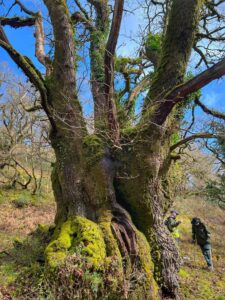
Image credit: Cheryl Silvawood
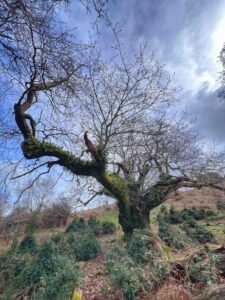
Image Credit: Cheryl Silvawood
Jill expressed that not enough new pollards are being created across our landscapes despite hedges being restored (while retaining trees amongst them). Mat mentioned that there is a big move on agroforestry in France, to start re-pollarding or establishing pollards, and hopes there will be value in product in the future to sustain the historic practice and uphold tradition at the same time, while keeping an eye on what the future might bring in terms of energy and food sources.
The popular question of ivy on veteran trees was also discussed; the denser ivy gets the more shading occurs on potential epicormic growth if a tree’s crown embarks on the retrenchment (reorganisation) process, leading to management that has to be sensitively undertaken.
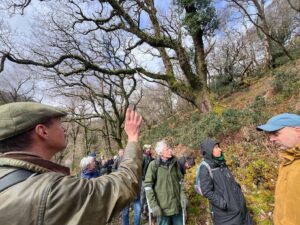
Jon Burgess speaking
Image Credit: Cheryl Silvawood
Another interesting topic of discussion was veteran trees evolving across areas between woodland habitat and open heathland, both habitats being nationally and internationally important. Where boundary is questionable, should we let woodland expand up the slopes and lose vital heathland habitat, or do we control the spread of trees (regeneration) up the slope?
Jill suggests “We’ve compartmentalised things into woodland and heathland and it’s a manmade construct. I’m not a fan of the term ‘woodland’ anymore, because it’s too focussed on closed canopy and we should be thinking about this as a massive wood pasture system open to grazing including beneficial managed deer populations. The habitats should be able to dance across the landscape creating a more open mosaic. Beech, for example, will prefer more closed canopy, whilst oak and other species clearly want to regenerate out in the open areas.”
The group rounded up the day with a visit to the impressive 500+ year old oak called ‘The General’, which is situated firmly on a scree slope.
The Devon ATF Local Group would like to thank the National Trust team at Holnicote for guiding the walk, generously sharing information about their management work and ideas for the future.
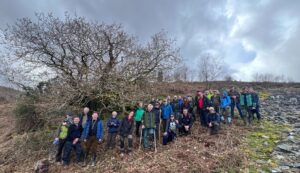
Devon ATF in front of The General at Horner Wood
Image Credit: Cheryl Silvawood
Cheryl Silvawood
ATF Trustee
ATF Devon Local Group

