


12th January 2024
Essex ATF Local Group: field trip to Furze Wood – 16th December 2023
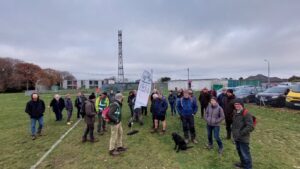
Image credit: James Chambers – Attendees gathering with the volunteers at the event meeting point, by our prized ATF flag!
The Essex ATF local groups final veteran tree walk of 2023 involved approx. 35 attendees, and a multitude of truly magnificent trees at the wonderful Furze Wood, Mistley.
This location is host to several ancient veteran oak pollards, and something of a hidden gem as many of the attendees hadn’t been aware of the location and its trees before the event.
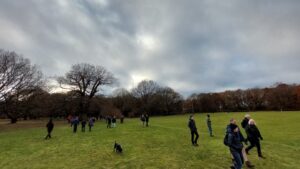
Image credit: James Chambers – heading off from the first tree of the event, “Mistley’s Majesty”.
We started the walk at “Mistley’s Majesty”, a lovely hollow old oak pollard with lots of character, before heading into the woods. There was a rugby match shortly after this photo was taken, but due to our careful planning and ‘precise time management’ (ahem), we were already in the woods by then.
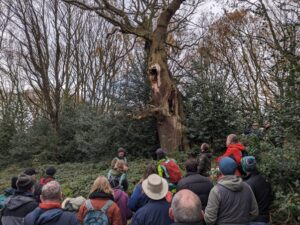
Image credit: Steve Woodley – talking through the many interesting features of a veteran oak tree.
Our next stop was by another lovely old hollow oak which has historically lost limbs both up in the crown and lower down the stem, providing lots of wildlife habitat potential.
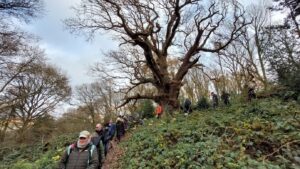
Image credit: James Chambers – “Big Foot”, a mighty ancient veteran oak pollard of national special interest, with the attendees slowly tearing themselves away!
Big Foot, a truly magnificent ancient oak pollard prompted much discussion and interest. While the group were admiring the tree, a resident from a nearby property noticed us and called out “…that tree is 700yrs old!”. We were grateful for the advice, and certainly couldn’t argue with the estimate!
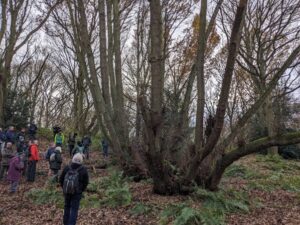
Image credit: Steve Woodley – admiring a huge old alder coppice!
We then moved on to a remarkable alder coppice with a huge basal circumference. There is another, smaller alder coppice not far away as well. This prompted interesting discussion about the history of the site, with ancient coppice and pollards in fairly close proximity. How had this unusual combination of circumstances come about, over the ages?
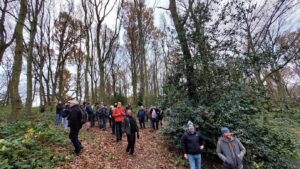
Image credit: James Chambers – A mirthful moment during our exploration of the woods.
It’s important to thank all the attendees for making the event so enjoyable. There were many interesting discussions with questions and answers from all participants, particularly some knowledgeable locals who shared information about the remains of some military buildings which are dotted in between the trees here and there.
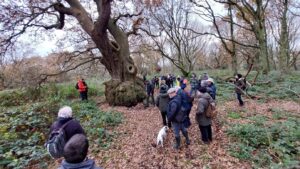
Image credit: James Chambers – amazing growth around the base, visually similar to “The Crinoline Lady” at Thorndon Country Park.
Those of us who’d been on one of our earlier walks this year recalled “The Crinoline Lady” from Thorndon Country Park and noted the visual similarities with another old oak pollard at Furze Woods. We discussed the various theories about this unusual kind of growth might be explained.
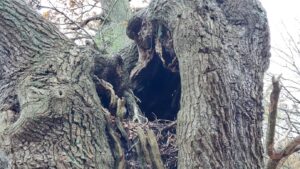
Image credit: James Chambers – An impressive adventitious root in “Mistley’s Monster-ess”
Another interesting feature was some well-established internal adventitious rooting in one of the large old oaks. A remarkable demonstration of natural recycling taking place as the tree draws on the nutrients becoming available decomposition of internal wood, which once formed the trunk of the tree itself!
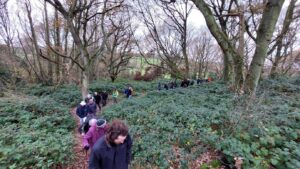
Image credit: James Chambers – The group following a trail through the woods!
Furze Woods isn’t a huge site, but there is lots to see. There are several well worn tracks meandering around the site, which doubtless provides habitat for a range of wildlife throughout the year.

Image credit: Steve Woodley – all the attendees gathered by “Old Knobbly”, another magnificent ancient oak pollard of national special interest.
One of the highlights of the day was meeting “Old Knobbly”, another important, named tree of national special interest, and the most famous tree at the site.
This old beauty prompted lots of discussion about how best to manage ancient and veteran trees, in order to prolong their lives as much as possible.
The tree has been suffering physiologically of late, probably due to a combination of factors such as recent hot summers, soil compaction and sadly, vandalism as it has been set on fire in the past.
Perhaps some mulch and a low fence with some signage explaining the importance of this tree (and ancient trees in general) might help?

Image credit: A helpful attendee using James Chambers phone. The Essex ATF volunteers (minus Matt who sadly couldn’t make it).
Once again, we’d like to thank all the attendees who make these events so interesting and enjoyable. This was a particularly interactive event, exactly as we’d hoped and always seek to encourage.
Lots of really interesting questions, local knowledge and valuable input from another fabulous group.
We’re very much looking forward to at least four events in 2024 and encourage anyone who has any interest in visiting and discussing ancient and veteran trees to join us, no tree expertise necessary! Of course, fellow arbs are also very welcome!
Hope to see you in 2024, tell your friends!
Steve Woodley and James Chambers


Linda DOLATA says:
Posted January 13, 2024 at 10:01 am
Another superb walk and ongoing discussion, thank you so much. Interesting throughout, with lots of discussion over the trees, plus input from mycologists and bat experts where relevant. I looked up the site afterwards, as the oldest trees were obviously open-grown, then infilled with self seedings? then much younger secondary growth..and mr Google obliged. There had been a medieval Deer Park since hunting was mentioned, so it was likely (as most attendees surmised) that the oldest trees were once Wood Pasture. Later on there was a hall built allegedly on the site of the original manor, but this too has now gone (although a print of the building showed open pasture with a couple of big trees ). A stable block persists as quiant housing so the site of the manor could be deduced. As you may tell, I found the whole day fascinating, which is why i tried to find out more. Thank you once again for superb organisation and input.
P.S. Anyone who doesn’t yet know about it…PLEASE get TED GREEN’s book TREETIME. Its’ a total must, and packed with questions and suggestions as well as his many decades of experience.