


27th August 2026
Summer Forum 2026 – Presentations and Recordings
Our huge thanks to the speakers and workshop leaders at the Summer Forum 2026 in Scotland and to everyone who attended. The event was a great success and we’re pleased to share the links to the presentations and video recording from the first day of talks. A more detailed report from the Summer Forum is available here: Summer Forum 2026 – Report and Reflections
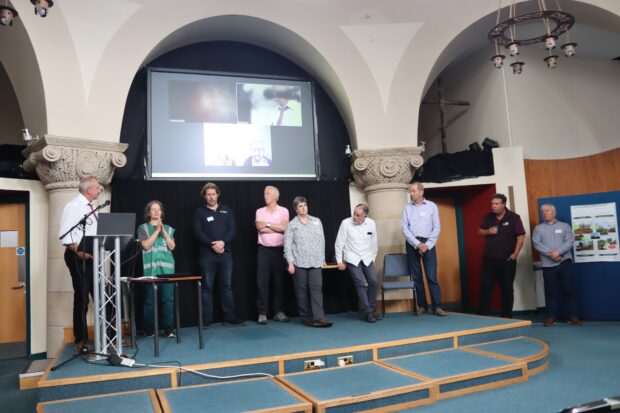
Image: Presenters on the stage for audience Q&A (Credit: Simon Stuart)
Links to presentation slides and recordings:
Talk 1: Ted Green (ATF founder) – Exploring Tree Myths including the Scots Pine and the Celtic Maple
Video recording: https://youtu.be/Dv-BFxC-1gY
Talk 2: Jon Stokes (The Tree Council) – An Update on Iconic Tree Policy, Protection and Education
Slides: Jon Stokes Presentation
Talk 3: Jill Butler (ancient tree specialist) –
Video recording: https://youtu.be/MTxVGbcrVsg
Talk 4: Russell Miller and James Chambers (arboricultural consultants) – Morphophysiology Stage 8 – the gateway to veteran or death
Slides: Russell Miller & James Chambers Presentation
Talk 5: Kevin Frediani (National Trust for Scotland) – Counting Cavities, Not Just Canopies: TreMs for Scotland’s Ancient Trees
Slides: Kevin Frediani Presentation
Talk 6: Paul Greenwood (SYTHI- Scotland’s Yew Tree Heritage Initiative) – The Yew in Scotland
Slides: Paul Greenwood Presentation
Talk 7: Tansy Lee Moir (Artist) – Looking at ancient trees through an artist’s eyes. How observing and drawing trees
can promote care and connection
Slides: Tansy Lee Moir Presentation
Talk 8: Chris Puddephatt (Photographer) – Wych Elms in Assynt
Slides: Chris Puddephatt Presentation
Talk 9: Helen Read (Ancient Tree Forum) and Simon Richmond (Arboricultural Association) – Developing the Skilled Workforce needed to Safeguard the UK’s ancient and other veteran trees
Slides (Helen Read): Helen Read Presentation
Slides (Simon Richmond): Simon Richmond Presentation

25th August 2026
A Personal Tribute to Neville Fay
By Ted Green – Founder President of the ATF
The tree care world lost a key figure, and I lost a great friend and ancient tree ally, when Neville Fay died on 17 August 2026 after a short illness.
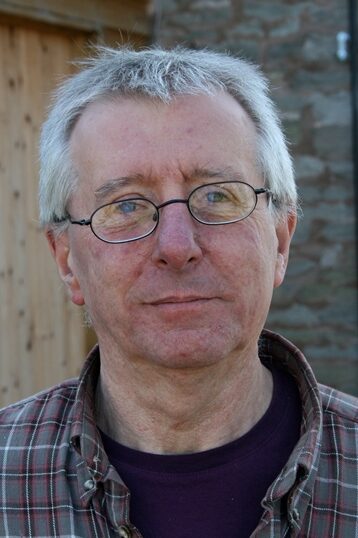
Neville Fay (Credit: ATF)
Keith Alexander and I met Nev in March 1994. By then, there was a growing group of people who were meeting frequently at sites with ancient trees. Nev had been commissioned to work on trees at Ashton Court and we went there to meet him and discuss his management work. Soon after I met him, we talked about how I was watching the ancient oaks in Windsor Great Park grow downwards. This inspired Nev to develop his ideas about Conservation Arboriculture. He coined the phrase that ‘there should be no further avoidable loss of ancient trees’ – one that should always remain an aim for the ATF and the Arboricultural Association.
Nev immediately joined our group and from this time on played a very significant part in the formation of the Ancient Tree Forum (ATF). Building on his experience of working with Tree Aid, Nev led the way in developing the ATF into a charity and Nev was its excellent first chair. By 1996 there was such awareness of the importance of ancient trees that English Nature (later Natural England) developed the Veteran Trees Initiative (1996-2000) which set up various projects and ran many events around England to help spread the word. Nev and I contributed to many of these events and I had a lot of time to get to know him. Through the Initiative, Nev developed the Specialist Survey Methodology and contributed to the guidance materials for the management of ancient trees. He went on to work with others in the production of the National Tree Safety Group and set up the Sustainable Soils Alliance.
We also travelled together to many important European places such as the forest at Fontainebleau, to Versailles to see the impacts of the 1999 ‘hurricane’ and the pollards in the French and Spanish, Basque Pyrenees. As our experience grew, we went on to share platforms together not only in the UK but in many other European countries and Nev became an international leading light for old trees.
Nev excelled at bringing people together, drawing out individual contributions and giving people recognition for their efforts. He would make people feel appreciated and inspire them to get more involved. Through collaboration with other like-minded specialists, he ran a number of very well attended and highly regarded Innovations in Arboriculture Seminars on a wide range of topics. His background in tree work ensured that he always kept a focus on raising standards in the management of ancient trees.
Nev read widely, thought deeply and wrote a great many articles and several books about the care of ancient trees. He would love to weave in metaphysical associations which helped to challenge one’s depth of understanding! He leaves a great tree care legacy.
When I became less mobile and was less able to join so many events, Nev made a point of ringing me up by phone to have a chat – typical of his thoughtfulness and shows the measure of the man. Goodbye to a very special person. Friendships made under a tree last the lifetime of the friends.

Neville Fay (Credit: Rob McBride)
25th July 2026
ATF West Midlands Visit to Brankley Pastures
by James Butler-White
On the 18th March the West Midlands and Worcestershire group held our 1st field visit of 2026.
The walk took in the ancient coppiced Holly and the woodland pasture at Brankley Pastures, which is full of ancient and veteran Oaks, Apples, Holly and Sweet Chestnuts. In the afternoon we spent a few hours recording the many ancient coppiced Hollies onto the Woodland Trust Ancient Tree Inventory.

Brankley Pastures, managed by the Staffordshire Wildlife Trust, is a nature reserve near Yoxall, Staffordshire, currently undergoing long-term restoration to wood pasture. Formerly part of the historic, 9,000-acre Needwood Forest in the 1700s, the land was cleared for agriculture during the 1800s enclosures before being repurposed for conservation.
The unique grove of ancient coppiced Holly or Hollins at Brankley is thought to be centuries old. Before the widespread introduction of turnips, Holly was heavily cultivated as winter fodder for cattle and sheep. In areas like the Pennines in north-west England, dedicated Holly groves known as “Hollins” were established. Farmers would pollard or coppice the trees, as the new regrowth produced softer, less prickly leaves that were more palatable for livestock.
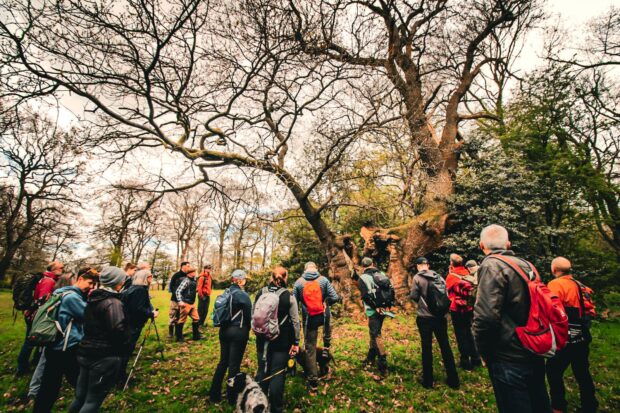
It’s always fantastic to share the day with so many like-minded tree people who share a love of ancient trees. Thank you to everyone who attended and a huge thank you to Katie Erin Lewis for helping out and for your support on the day.
Hope to see some of you at our next walk on 3rd September 🌳

All Image Credits: James Butler-White
Report from Herefordshire Parkland Conference – 1-3 July 2026
by Cheryl Silvawood (ATF Trustee, Technical Advisory Panel (TAP) Board Representative and Action Oak Representative)
From 1st to 3rd July, I had the opportunity to attend the Herefordshire Parkland Conference at NMITE Skylon Campus, on behalf of the ATF. The conference – dedicated to the memory of David Lovelace who unfortunately passed away in May this year – was organised by the Woolhope Naturalists’ Field Club as part of their 175th anniversary celebrations. Bringing together researchers, scientists, conservationists, landowners, stakeholders and various conservation organisations, the conference aimed to share knowledge, expertise, latest findings, address cultural and historical topics, highlight the importance of how climate change, pests and diseases are affecting our trees, while also showcasing the beauty and value of our parkland landscapes.
The ATF were invited to set up a stand showcasing the work we do in securing the long-term future of ancient and other veteran trees, events we hold with local groups, as well as training for professionals. I was joined by Jon Burgess (ATF Devon and Woodland Resilience Officer at Forestry Commission) and Richard Powell OBE (ATF Chair).
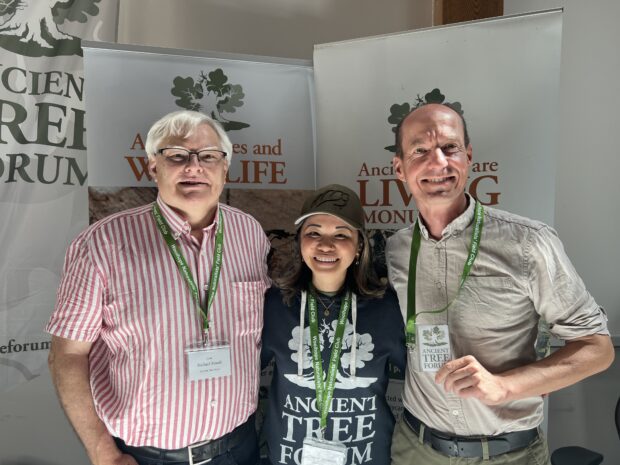
Image: Richard Powell OBE (left), Cheryl Silvawood (centre) and Jon Burgess (right) at the ATF stand. Image credit: Cheryl Silvawood
Day One:
After introductions from Prof. Rachel Jenkins (Vice President at the Woolhope Club) and Edward Harley CBE (Lord Lieutenant of Herefordshire), we were given a brief history of Herefordshire’s parklands by David Whitehead FSA, then a presentation on archaeology by Professor Keith Ray MBE of Herefordshire Archaeology. We were then shown how artists have historically documented their landscape views and impressions through art in a presentation by Prof. Charles Watkins (University of Nottingham). Geology and the geo-conservation of the parklands was discussed by Moira Jenkins from the Woolhope Club, and ecologist and environmental consultant Will Watson explained the evolution of freshwater habitats and the existence of Ice Age ponds in Herefordshire’s parklands. Finally, we had Neil Ford from the Ancient Woodland Inventory, Natural England, presenting the National Inventory updates on ancient woodland and the implications on wood pasture and parklands. The group discussion was chaired by James Marsden, former Chair of the Herefordshire Climate & Nature Partnership Board.
After lunch we had the choice of visiting Brampton Bryan or Gatley Park; I was on the coach for the former. Edward and Victoria Harley, who have been managing Brampton Bryan for 25 years, took us on a walk around the estate, where they explained the management practices they have adopted since taking ownership. We were shown the impressive avenues of veteran sweet chestnuts planted from the 1660s, and how they have attempted to close the age gap between younger and older trees by planting newer trees suited to the existing landscape.

Image: Ancient sweet chestnut at Brampton Bryan. Image credit: Cheryl Silvawood
There was much discussion about acute oak decline (AOD), which was apparent in some of the more standalone maiden trees in the parkland, some of which had died. Being a complex emerging disease caused by multiple agents, especially bacteria, AOD has affected our oak trees, and could easily kill them within four to six years with the onset of symptoms. For infection to occur the trees need to be predisposed by factors, especially environmental (1). With climate change being a major culprit in advancing the spread of AOD, it was vital that fellow delegates from Forest Research shared important AOD findings with us during these discussions, challenging that there has to be other alternatives to wood chip mulching, when wood chip provenance and decaying condition could be counterintuitive to a tree’s nutrient absorption process and affecting the sensitive microbiome, which can result in a tree’s deterioration in the face of climate change.
Day Two:
Our morning sessions kicked off with Stuart Hedley, County Recorder for Herefordshire’s vascular plants, who gave a presentation about vegetation. Caroline Hanks, Director of Herefordshire Meadows, then presented on the flower-rich parkland swards with semi-natural habitats in a designed landscape, giving us a rich insight into her project and its achievements in engaging people and communities. Professor Lynne Boddy MBE, from Cardiff University, then delivered a rousing talk about fungi in the life of trees, presenting data findings and many examples of existing and new fungi found on our veteran and ancient trees. Nigel Pilling, Wood Pasture and Parkland Senior Specialist at Natural England then followed with a presentation on tree population sizes required to ensure veteran tree continuity in wood pasture and parklands. Victoria Heffer, CEO of Radnorshire Wildlife Trust, chaired the discussions that followed.
After a break, we continued with Dr. Sandra Denman, Principal Pathologist at Forest Research, presenting her research on AOD and the relationship with Agrilus biguttatus, sparking many questions from the audience. Dr. Daegan Inward from Forest Research then talked about the changing nature of forest pests in Britain, followed by Dr. Ruth Mitchell, Woodland Ecologist at James Hutton Institute, who presented a pre-recorded video on the ecology of the British oak, implications of its decline and mitigation options. Lastly, we had Dr. Elena Vanguelova, Senior Biogeochemist in Soil Sustainability Research at Forest Research, presenting on woodland creation, succession and soil health. The two parts of the morning talks were summarised in panel questions and discussions, chaired by Saul Herbert of Herefordshire Wildlife Trusts, with some interesting questions from the audience and fellow panellists.
The afternoon site visits were either Moccas or Eastnor & Bromesberrow. As Moccas was high on my places to visit, I was grateful to be given that opportunity. Francis Chester-Master, whose family had inherited the estate from Sir William Cornewall in 1962, introduced the park’s history, followed by Tom Simpson from Natural England who was involved in the management of the estate. Created sometime in the 1500s, Moccas Park’s 150 hectares contains 2500-3000 trees, of which 585 are veteran and 130 of the veterans classed as ancient. There are over 1100 species of fly, 800 species of beetle, 14/15 species of bats, all the woodpeckers, as well as spotted flycatchers. Two distinct zones – the lower park (a design landscape with parkland features and wood pasture) and the upper park (wild wood pasture where natural processes take place) – make up Moccas’ landscape habitat. Another interesting landscape mentioned was Moccas Hill Wood, which used to be a large plantation clear felled 16 years ago, now a great example of wood pasture restoration through grazing and some mechanical intervention.
As we walked through the incredible Tudor created landscape, there was a veteran tree everywhere we turned. We were introduced to the site’s incredible ancient ash tree, estimated to be over 500 years old and one of the largest girthed and oldest specimens in the country, as well as the ‘Old Man of Moccas’, a famous, gnarly ancient oak believed to be 850 years old. We were also shown the Ice Age pond that resided in the lower parkland, and had discussions about tree succession, improved grazing strategies to allow the parkland to recover and restore, as well as soil restoration trials with ‘radiation-shaped’ wood chip mulching around trees.

Image: Ancient ash at Moccas. Image credit: Cheryl Silvawood
Day Three:
The morning started with Prof. James McDonald, professor of Microbiology at Birmingham University, giving a presentation on characterising and engineering the oak microbiome to suppress disease. Dr. Mariella Marzano OBE, Principal Social Scientist at Forest Research, then discussed the social dimensions of oak landscape management, and the public’s perceptions of tree disease and conservation. Alice Dibley, PhD student at University of West of England, presented her findings of soil rhizosphere and naturalistic management strategies. On behalf of Dr. Nathan Brown from Forest Research, Dr. Sandra Denman also talked about monitoring oak health and the role of stakeholder scientists.
The early morning’s sessions were then followed by a panel discussion chaired by ATF’s Chair, Richard Powell OBE. After a break, we carried on with Geoff Monck from Treecosystems Ltd who talked about his industry techniques in using regenerative arboriculture to restore tree decline, and then ATF’s Technical Advisory Panel expert Reg Harris (Urban Forestry) shared his experiences with trees in parklands and heritage landscapes, through his long career of ancient and veteran tree arboriculture management. Tom Oliver, Chair of the Council for Preservation of Rural England, Herefordshire, came on stage to talk about averting loss and recovering life in Croome Park’s restoration efforts. Summing up key issues arising from the conference was presented by Dr. Matthew Wainhouse from Natural England, and Dr. Sandra Denman stepped up again to present her and Dr. Carrie Brady’s visions for a future research agenda rooted in science and collective collaboration, for the health and resilience of British oak. The final discussion panel, chaired by Annabel Narayan, CEO of Action Oak, fielded questions from the audience and discussed future action for treescapes.
Our afternoon site visits were scheduled for Kentchurch or Holme Lacy. I headed to Kentchurch and we looked at some of the estate’s management processes as well as meeting the famous Jack of Kent’s Oak. The heatwave and fair weather had been consistent throughout the conference and this day was no different. I met Archie Miles, writer and photographer of the book ‘Ash’, as he led us on a guided walk through Kentchurch estate. Archie showed us some amazing yew trees and sweet chestnuts and as the sun beat down on everyone, it became even more apparent that some trees were showing signs of struggling with the increased temperatures. It was an opportunity to catch up with colleagues from the Woodland Trust, Natural England and DEFRA, to name a few, as we discussed latest management initiatives and potential collaborative opportunities between organisations and groups involved in parkland and wood pasture restoration and conservation, including ancient and other veteran trees.

Image: Jack of Kent’s Oak at Kentchurch. Image credit: Cheryl Silvawood
The Herefordshire Parkland Conference was a major success. Underpinning the entire conference was a common passion to keep our parklands, wood pastures and all associated wildlife and habitat sustainable, while working together in collaboration to make restoration of habitats, increasing resilience and biodiversity of such landscapes possible. On behalf of the ATF, I would like to thank the Woolhope Naturalists’ Field Club for hosting us and organising such a brilliant event.
References:
1. https://www.forestresearch.gov.uk/tools-and-resources/fthr/pest-and-disease-resources/acute-oak-decline/
24th July 2026
ATF Devon Visit to Watersmeet
by Jon Burgess
In June, the ATF Devon group were kindly hosted by Dan Cameron and the National Trust team from North Devon on a visit to the Watersmeet estate in the heart of Exmoor. Watersmeet is named for the confluence of two rivers in a deeply incised valley covered in oak woodland. The visit was slightly different to our normal outings as we were looking at the management of the woodland as much as the veteran trees, although these were still present in good numbers.
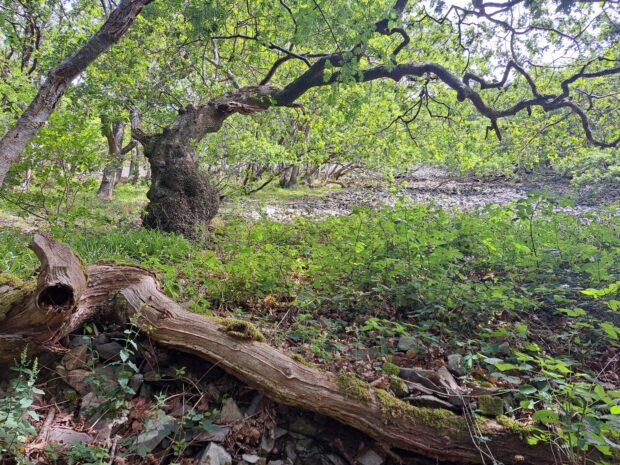
The oak woodland was single-aged and lacking much understorey, having originated from lapsed coppice stools many decades previously. Dan and his team were looking to start a pollard cycle, creating structural diversity, some open space and haloing around the veteran trees. This work will make the habitat much more complex and interesting and hopefully help support the butterfly populations that the region is known for, such as the heath fritillary butterfly, also known as the “woodman’s follower” given it’s association to coppicing.
The pollarding of old coppice stools could create unusual ‘Coppards’. Selecting to cut higher would protect the regrowth from the abundant local deer populations. Whilst some trees were cut others were snapped with a winch to create natural fractures and promote micro-habitat formation within the trunks. The response of the trees to this work is variable but enough show strong epicormic growth to suggest that the experiment is an early success. Some of the older oak coppice stools had survived on persistent scree slopes which are a feature of these valleys, some of these have recently died but will be retained as valuable deadwood habitat long into the future.

A strange highlight was a relatively young but very famous tree – the original Sorbus admonitor, also known as the ‘No-parking Whitebeam’ named for the sign that was once nailed to it, long before it was identified as a unique Whitebeam species that is present in the valley. The tree itself shows a deteriorating stem but abundant regrowth from the base, so its future looks assured in the safe hands of the local team.

All Image Credits: Jon Burgess
25th June 2026
Event Report: Summer Forum 2026 in Motherwell, Scotland

The Summer Forum 2026 (jointly organised by the ATF and AA Scotland) was a resounding success, with a wide range of fascinating talks, and a wonderful day of workshops and walks under the stunning ancient boughs of the Cadzow Oaks. The theme of the Forum was ‘Open-grown Trees: from Conversation to Conservation’. You can read Clare De Villanueva’s report and reflections on both days of the Summer Forum by clicking here: Summer Forum 2026 – Report and Reflections
We’d like to say a huge thank you to all of the speakers, workshop leaders, volunteers, and venue staff who contributed so much of their time and expertise. We’d also like to thank all of the wonderful delegates, who contributed a wealth of knowledge, experience and good humour to the occasion! We’re very excited about setting up an ATF Scotland branch – if you’d like to be involved in ATF Scotland and didn’t make it to the Summer Forum, please email jenny.ramsay@ancienttreeforum.org.uk to join the Scotland mailing list.
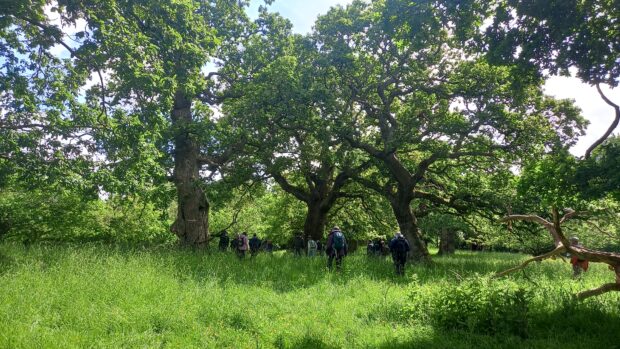
Image Credits: Jenny Ramsay
18th June 2026
Lessons from Sherwood’s Major Oak Must Help Protect Britain’s Ancient Trees
The Ancient Tree Forum (ATF) is extremely saddened to hear of the demise of one of Britain’s most iconic trees. Famous throughout the world, the Major Oak has inspired awe and wonder in countless visitors who have made pilgrimages to Sherwood Forest. We offer our condolences to the staff at Sherwood Forest and to local people, for whom this moment may not be unexpected, but is nonetheless deeply painful.
Commenting on the loss, Richard Powell OBE, Chair of the Ancient Tree Forum, said:
“The Major Oak is one of Britain’s most celebrated trees and its loss will be felt far beyond Sherwood Forest. While we mourn the passing of this remarkable tree, we must also learn from its story. Ancient trees are irreplaceable living monuments and complex ecosystems. The lessons learned at Sherwood can help us better protect and nurture the nation’s precious ancient trees for future generations.”
It is clear from historic photographs that the tree has been a centre of attraction for well over a century. The critical importance of the unseen underground roots and the myriad soil organisms that support all trees has only been fully appreciated and understood in relatively recent times. We now know that the impact of large numbers of people walking and standing on the ground around a tree can be severely detrimental to its health.
We also recognise that past management of ancient trees, whilst carried out with the best interests of the tree in mind, may not today be considered appropriate. Our understanding of how best to care for ancient trees has developed significantly over time, particularly in relation to the importance of natural processes and long-term tree health. It is possible that some historic interventions, undertaken with good intent, may have contributed to the tree’s decline.
The RSPB have been deeply concerned about the tree’s condition and have actively sought and followed expert advice in an effort to ameliorate past damage and arrest its decline. They deserve considerable credit for these efforts during what must have been a challenging and emotional time.
Sherwood Forest is more than a single tree. Its other ancient oaks are spectacular trees with distinct forms and characters. These trees are receiving a great deal of care and attention from the RSPB, and considerable effort is being made to ensure that they continue to thrive despite unavoidable pressures such as a changing climate.
While the loss of such an iconic tree is both sad and upsetting, we should also remember that Sherwood Forest, and Britain as a whole, still contains many charismatic ancient trees that we can value, nurture and visit.
We at the Ancient Tree Forum continue to learn from historic management practices in order to increase our understanding and improve the care of our most precious trees and to build a growing network of specialists with expertise in ancient tree management, including through initiatives such as the VETcert certification scheme, for which the ATF provides training in the UK. We hope that the lessons learned from Sherwood and other important sites can be shared widely to help safeguard the future of our oldest and most valuable trees.
Press Enquiries: Please contact admin@ancienttreeforum.org.uk

14th May 2026
Event Review: Visit to King’s Ely (ATF East Anglia)
By Natalie Lambert and Kenny McGregor
ATF Visit to King’s Ely and the Great London Plane of Ely

The Ancient Tree Forum East Anglia Group’s visit to King’s Ely provided a valuable opportunity to see one of the most remarkable trees in the country, the Great London Plane of Ely.
The majesty of the tree is difficult to overstate. At around 360 years old, it is recognised as one of the oldest and most significant London Plane trees in the UK. It is also understood to be one of the original London planes introduced to this country, and is traditionally believed to have been gifted by King Charles II to Peter Gunning, Bishop of Ely.
Before visiting the tree, David Day, Chair of Governors at King’s Ely, gave an informative presentation on the background to the project, including the grant funding secured through the National Lottery Heritage Fund, and the specialist engineering work led by Dr James Talbot, Associate Professor of Engineering at the University of Cambridge. This helped set the context for the conservation work, the importance of the tree, and the ambition behind securing its future.

The group was then given a tour of the tree and surrounding gardens by Will Temple, Grounds and Gardens Manager, who provided further insight into the site, its history and the importance of the tree within the wider landscape. This helped bring the setting to life and gave valuable context to the ongoing care and management of such a significant specimen.
Particular attention was given to the specialist engineering work led by Dr James Talbot and his team at the University of Cambridge. This pioneering work brings together arboriculture, engineering and research, using structural modelling, laser scanning, vibration measurement and real time monitoring to better understand the movement and loading of the compromised limb. The work is helping to inform a support system that provides structural assistance while allowing the tree to move as naturally as possible.
The visit was both inspiring and thought provoking. It highlighted the importance of collaboration between arboriculturists, engineers, landowners, funders and heritage specialists when caring for exceptional trees. The Great London Plane of Ely stands as a powerful example of what can be achieved when ambition, technical expertise and passion for living heritage come together.

Image credits: Natalie Lambert
23rd April 2026
A Small Charity with a BIG Impact
The Ancient Tree Forum is a small charity, but we pack a big punch when it comes to safeguarding ancient trees. With a small team of part-time staff, we achieve a great deal thanks to the dedication, expertise and passion of our wonderful volunteers and supporters. When you donate to the ATF, you know that your money will go a long way. This week (22 – 29 April), your donation can go even further – if you donate to the ATF via the Big Give website, your donation will be doubled by Big Give funders!
Every penny raised this week will help to protect ancient trees by contributing to:
- ATF courses to equip people with specialist skills and knowledge to care for ancient trees
- ATF meetings and working groups to develop and strengthen guidelines and legislation
- ATF events and conferences to share expertise, research and ideas
- ATF communications and campaigns to raise awareness of the unique and vital importance of ancient trees
If you’d like to make a big difference for ancient trees, please click here to donate today and double your impact. Every penny helps – thank you!

Image Credit: James Butler-White
22nd April 2026
Event Review: Visit to Hatfield Forest (ATF Essex)
By Anthony Mills
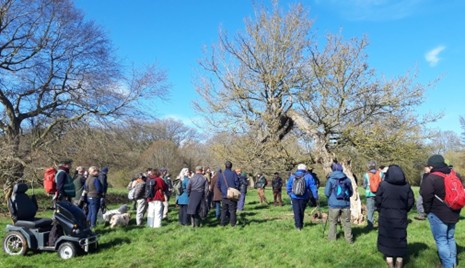
Having spent the past couple of weeks doing my homework and ploughing through Rackham’s ‘’The Last Forest’’, on Saturday 14th March I was welcomed to the ATF Essex group meeting at Hatfield Forest with a ‘’Tramper’’ all-terrain mobility scooter that James Chambers and the National Trust had kindly arranged for my use. Good job or I’d not have made it more than a couple of hundred meters over the level but very uneven ground.
It was a pleasure to be greeted again by James Chambers, leading the visit, assisted by ATF volunteers in green ‘Lo-Vis’ vests. In all there were 55 attendees, a very respectable turnout, for a truly fascinating and rewarding site.
Click here to read the full report.

Image credits: Anthony Mills
