


25th July 2026
Report from Herefordshire Parkland Conference – 1-3 July 2026
by Cheryl Silvawood (ATF Trustee, Technical Advisory Panel (TAP) Board Representative and Action Oak Representative)
From 1st to 3rd July, I had the opportunity to attend the Herefordshire Parkland Conference at NMITE Skylon Campus, on behalf of the ATF. The conference – dedicated to the memory of David Lovelace who unfortunately passed away in May this year – was organised by the Woolhope Naturalists’ Field Club as part of their 175th anniversary celebrations. Bringing together researchers, scientists, conservationists, landowners, stakeholders and various conservation organisations, the conference aimed to share knowledge, expertise, latest findings, address cultural and historical topics, highlight the importance of how climate change, pests and diseases are affecting our trees, while also showcasing the beauty and value of our parkland landscapes.
The ATF were invited to set up a stand showcasing the work we do in securing the long-term future of ancient and other veteran trees, events we hold with local groups, as well as training for professionals. I was joined by Jon Burgess (ATF Devon and Woodland Resilience Officer at Forestry Commission) and Richard Powell OBE (ATF Chair).
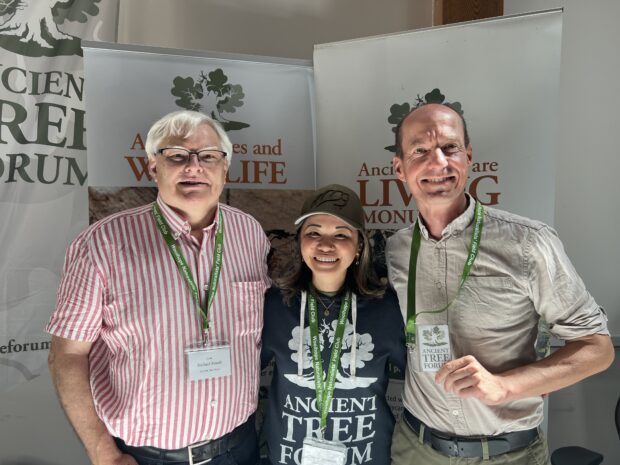
Image: Richard Powell OBE (left), Cheryl Silvawood (centre) and Jon Burgess (right) at the ATF stand. Image credit: Cheryl Silvawood
Day One:
After introductions from Prof. Rachel Jenkins (Vice President at the Woolhope Club) and Edward Harley CBE (Lord Lieutenant of Herefordshire), we were given a brief history of Herefordshire’s parklands by David Whitehead FSA, then a presentation on archaeology by Professor Keith Ray MBE of Herefordshire Archaeology. We were then shown how artists have historically documented their landscape views and impressions through art in a presentation by Prof. Charles Watkins (University of Nottingham). Geology and the geo-conservation of the parklands was discussed by Moira Jenkins from the Woolhope Club, and ecologist and environmental consultant Will Watson explained the evolution of freshwater habitats and the existence of Ice Age ponds in Herefordshire’s parklands. Finally, we had Neil Ford from the Ancient Woodland Inventory, Natural England, presenting the National Inventory updates on ancient woodland and the implications on wood pasture and parklands. The group discussion was chaired by James Marsden, former Chair of the Herefordshire Climate & Nature Partnership Board.
After lunch we had the choice of visiting Brampton Bryan or Gatley Park; I was on the coach for the former. Edward and Victoria Harley, who have been managing Brampton Bryan for 25 years, took us on a walk around the estate, where they explained the management practices they have adopted since taking ownership. We were shown the impressive avenues of veteran sweet chestnuts planted from the 1660s, and how they have attempted to close the age gap between younger and older trees by planting newer trees suited to the existing landscape.

Image: Ancient sweet chestnut at Brampton Bryan. Image credit: Cheryl Silvawood
There was much discussion about acute oak decline (AOD), which was apparent in some of the more standalone maiden trees in the parkland, some of which had died. Being a complex emerging disease caused by multiple agents, especially bacteria, AOD has affected our oak trees, and could easily kill them within four to six years with the onset of symptoms. For infection to occur the trees need to be predisposed by factors, especially environmental (1). With climate change being a major culprit in advancing the spread of AOD, it was vital that fellow delegates from Forest Research shared important AOD findings with us during these discussions, challenging that there has to be other alternatives to wood chip mulching, when wood chip provenance and decaying condition could be counterintuitive to a tree’s nutrient absorption process and affecting the sensitive microbiome, which can result in a tree’s deterioration in the face of climate change.
Day Two:
Our morning sessions kicked off with Stuart Hedley, County Recorder for Herefordshire’s vascular plants, who gave a presentation about vegetation. Caroline Hanks, Director of Herefordshire Meadows, then presented on the flower-rich parkland swards with semi-natural habitats in a designed landscape, giving us a rich insight into her project and its achievements in engaging people and communities. Professor Lynne Boddy MBE, from Cardiff University, then delivered a rousing talk about fungi in the life of trees, presenting data findings and many examples of existing and new fungi found on our veteran and ancient trees. Nigel Pilling, Wood Pasture and Parkland Senior Specialist at Natural England then followed with a presentation on tree population sizes required to ensure veteran tree continuity in wood pasture and parklands. Victoria Heffer, CEO of Radnorshire Wildlife Trust, chaired the discussions that followed.
After a break, we continued with Dr. Sandra Denman, Principal Pathologist at Forest Research, presenting her research on AOD and the relationship with Agrilus biguttatus, sparking many questions from the audience. Dr. Daegan Inward from Forest Research then talked about the changing nature of forest pests in Britain, followed by Dr. Ruth Mitchell, Woodland Ecologist at James Hutton Institute, who presented a pre-recorded video on the ecology of the British oak, implications of its decline and mitigation options. Lastly, we had Dr. Elena Vanguelova, Senior Biogeochemist in Soil Sustainability Research at Forest Research, presenting on woodland creation, succession and soil health. The two parts of the morning talks were summarised in panel questions and discussions, chaired by Saul Herbert of Herefordshire Wildlife Trusts, with some interesting questions from the audience and fellow panellists.
The afternoon site visits were either Moccas or Eastnor & Bromesberrow. As Moccas was high on my places to visit, I was grateful to be given that opportunity. Francis Chester-Master, whose family had inherited the estate from Sir William Cornewall in 1962, introduced the park’s history, followed by Tom Simpson from Natural England who was involved in the management of the estate. Created sometime in the 1500s, Moccas Park’s 150 hectares contains 2500-3000 trees, of which 585 are veteran and 130 of the veterans classed as ancient. There are over 1100 species of fly, 800 species of beetle, 14/15 species of bats, all the woodpeckers, as well as spotted flycatchers. Two distinct zones – the lower park (a design landscape with parkland features and wood pasture) and the upper park (wild wood pasture where natural processes take place) – make up Moccas’ landscape habitat. Another interesting landscape mentioned was Moccas Hill Wood, which used to be a large plantation clear felled 16 years ago, now a great example of wood pasture restoration through grazing and some mechanical intervention.
As we walked through the incredible Tudor created landscape, there was a veteran tree everywhere we turned. We were introduced to the site’s incredible ancient ash tree, estimated to be over 500 years old and one of the largest girthed and oldest specimens in the country, as well as the ‘Old Man of Moccas’, a famous, gnarly ancient oak believed to be 850 years old. We were also shown the Ice Age pond that resided in the lower parkland, and had discussions about tree succession, improved grazing strategies to allow the parkland to recover and restore, as well as soil restoration trials with ‘radiation-shaped’ wood chip mulching around trees.

Image: Ancient ash at Moccas. Image credit: Cheryl Silvawood
Day Three:
The morning started with Prof. James McDonald, professor of Microbiology at Birmingham University, giving a presentation on characterising and engineering the oak microbiome to suppress disease. Dr. Mariella Marzano OBE, Principal Social Scientist at Forest Research, then discussed the social dimensions of oak landscape management, and the public’s perceptions of tree disease and conservation. Alice Dibley, PhD student at University of West of England, presented her findings of soil rhizosphere and naturalistic management strategies. On behalf of Dr. Nathan Brown from Forest Research, Dr. Sandra Denman also talked about monitoring oak health and the role of stakeholder scientists.
The early morning’s sessions were then followed by a panel discussion chaired by ATF’s Chair, Richard Powell OBE. After a break, we carried on with Geoff Monck from Treecosystems Ltd who talked about his industry techniques in using regenerative arboriculture to restore tree decline, and then ATF’s Technical Advisory Panel expert Reg Harris (Urban Forestry) shared his experiences with trees in parklands and heritage landscapes, through his long career of ancient and veteran tree arboriculture management. Tom Oliver, Chair of the Council for Preservation of Rural England, Herefordshire, came on stage to talk about averting loss and recovering life in Croome Park’s restoration efforts. Summing up key issues arising from the conference was presented by Dr. Matthew Wainhouse from Natural England, and Dr. Sandra Denman stepped up again to present her and Dr. Carrie Brady’s visions for a future research agenda rooted in science and collective collaboration, for the health and resilience of British oak. The final discussion panel, chaired by Annabel Narayan, CEO of Action Oak, fielded questions from the audience and discussed future action for treescapes.
Our afternoon site visits were scheduled for Kentchurch or Holme Lacy. I headed to Kentchurch and we looked at some of the estate’s management processes as well as meeting the famous Jack of Kent’s Oak. The heatwave and fair weather had been consistent throughout the conference and this day was no different. I met Archie Miles, writer and photographer of the book ‘Ash’, as he led us on a guided walk through Kentchurch estate. Archie showed us some amazing yew trees and sweet chestnuts and as the sun beat down on everyone, it became even more apparent that some trees were showing signs of struggling with the increased temperatures. It was an opportunity to catch up with colleagues from the Woodland Trust, Natural England and DEFRA, to name a few, as we discussed latest management initiatives and potential collaborative opportunities between organisations and groups involved in parkland and wood pasture restoration and conservation, including ancient and other veteran trees.

Image: Jack of Kent’s Oak at Kentchurch. Image credit: Cheryl Silvawood
The Herefordshire Parkland Conference was a major success. Underpinning the entire conference was a common passion to keep our parklands, wood pastures and all associated wildlife and habitat sustainable, while working together in collaboration to make restoration of habitats, increasing resilience and biodiversity of such landscapes possible. On behalf of the ATF, I would like to thank the Woolhope Naturalists’ Field Club for hosting us and organising such a brilliant event.
References:
1. https://www.forestresearch.gov.uk/tools-and-resources/fthr/pest-and-disease-resources/acute-oak-decline/


Anthony Mills says:
Posted July 29, 2026 at 6:15 pm
From that report, it looks to have been an astonishing experience, amazingly dense with both presentations over a wide range of topics and visits to some amazing sites. Must have taken quite some mental stamina to keep up especially in that heat. But what a fantastic aggregation of minds and knowledge! Might there be any publication of the proceedings in the future, as it seems to have been a summation of a great deal that is current in research and understanding about parklands and wood pasture?
Jenny Ramsay says:
Posted August 29, 2026 at 1:32 pm
Hi Anthony, yes, the conference organisers are working on a book based on the conference, which they hope to publish in early 2027. We’ll publicise this in the ATF newsletter when it’s available.