


27th July 2023
South Weald Park Fire Prevention in Ancient Oak Tree
South Weald Park near Brentwood in Essex is one of Essex County Council’s country parks, it has a good collection of ancient and veteran trees with many Oaks in the wood pasture area, these are in various states, many are old pollards some of which are hollowing.
About 10 years ago we were asked to advise on a tree that had been recently burnt, the tree, a large Oak pollard, was hollow with a small opening at ground level and a large opening at about 4 metres height, deadwood and material had been placed in the cavity from above and below and set alight, the lower opening acted as a vent and the upper as a chimney and according to a witness flames went metres in the air from the upper opening, the fire burnt itself out but later another attempt was made to build a new fire which luckily was prevented by the arsonists being disturbed.
I thought about various methods to prevent another fire and also the natural cycles of decay, hollowing and ageing of trees and how we might try and replicate these as well. The importance of wood mould occurred to me and how this is so valuable in hollow trees, the fact that it is naturally moist and therefore fireproof to a degree lead me to think of the properties of well-rotted woodchip as a substitute which may eventually replicate wood mould.
We could climb into the hollow stem from the upper opening and assess the cavity, any creatures in there at the time of the fire would have either left or perished but we checked in case any new inhabitants were there, the fire had completely charred the inside wall but it was still reasonably thick enough that the heat hadn’t killed the cambium, although this may occur in very thin walled hollow trees.
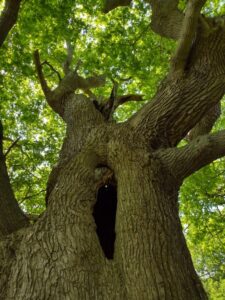
Image Credit: ATF
Fire damaged ancient oak, Weald Country Park
The park rangers had a supply of woodchip from the park trees which was brought to close by, this was to avoid importing any pest or disease on woodchip from afar but if you doing this any moist, well-rotted woodchip is better than none! We climbed into the cavity and attached 1 inch weldmesh which had been cut to fit around the inside of the lower opening with enough to allow the use of galvanised staples to attach it inside, this was to prevent the removal of the weldmesh. A pulley and small lowering rope were installed in the crown above the upper opening and the woodchip was hauled above and tipped into the cavity until it was full. The weldmesh prevented the woodchip from spilling out and the weight of the woodchip secured the weldmesh from tampering, within a small time period the weldmesh had surface rust and it was almost unnoticeable. This method is fairly flexible providing there is stable wood to attach the weldmesh, the gauge of the materials used can be varied according to the size of the area to cover but too thin a gauge may be easily damaged and too big mesh may leak woodchip.
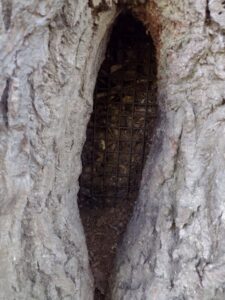
Image Credit: ATF
Weldmesh inserted to retain woodchip
Consider management plans for any trees at risk of fire damage and especially consider the availability of fire-starting materials, arsonists are very resourceful!
Deadwood piles and dead hedges are easy targets and we have seen them used many times often with very damaging results to trees, the ecological benefits of these alternatives to chipping or controlled fires may be outweighed by their potential to be used by arsonists.
10 years on and the Oak is looking great and the cavity is still full enough to prevent any further fires.

Image Credit: ATF
Establishment of a native hedge to reduce compaction around a veteran oak at Weald Country Park.

James Curry
jamescurryarborist@outlook.com


Hugh Milner says:
Posted July 31, 2023 at 1:38 pm
Well done.
The weld mesh will eventually fail but hopefully the mulch will remain fireproof. This needs monitoring indefinitely.