


10th November 2025
ATF Essex and ATF East Anglia – Visit to Melford Hall
by James Chambers (ATF Essex)
The day started with the traditional ritual of planting the ATF flag and gathering the attendees, including several of the Melford Hall team, who we were very pleased to have join us! This visit was very special as it was in conjunction with the newly formed ATF East Anglia local group, and we were joined by several members for their first veteran tree walk as the new team! Introductions and fire safety drill complete, we marched across the field to the ancient trees identified during our planning visit a few weeks earlier.

As soon as we arrived by the gate we gazed in wonder at the first tree of several in this spot, a moribund ancient oak, dying, but full of life with all sorts of invertebrates, lichens, bacteria, fungi, mosses, and who knows what else. So many interesting features and potential habitats to view – how and why had the tree grown this way, what was causing its decline, how long had it been there, why was this one suffering and others nearby seemingly in much better condition?

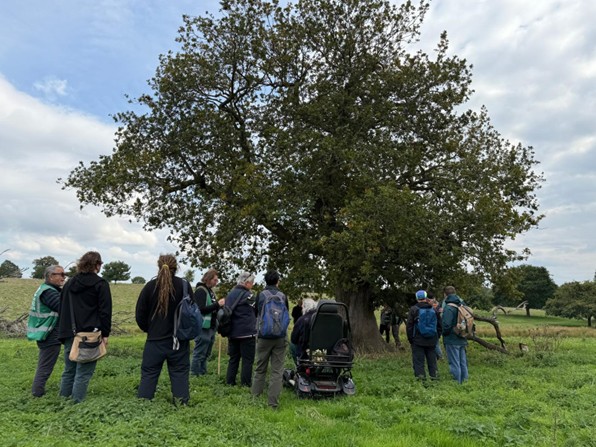
Later we gathered at another amazing tree, this one estimated (using John White’s method) to be somewhere around 500 years old. A very large trunk with cavities, decayed branches on the ground and in the crown, with enormous spreading buttresses all around the base to hold it up. It’s remarkable to note how the physiological condition of tree – as demonstrated by the full, green crown – remains so active and healthy after so many years.

At one stage of the proceedings Jim Chambers was required to count to 3 while holding a twig. It’s not clear why he was so keen to point this out to everyone.

Another view of the loverly 500yr old tree, see, I told you about those cavities and buttresses, didn’t I? Another remarkable example of how perfectly stable a hollow, decayed tree can be.
It’s a natural process, nature recycling itself as the tree and fungi work together to release locked up nutrients to their mutual benefit. Co-evolution in action. The good physiological condition of the tree, likely enabled to some extent by access to those ‘recently’ internal nutrients, allows the tree to gradually increase its girth each year, providing structural stability and strength while the hollow trunk offers habitat value. Trees have been doing this for many millions of years, far longer than humans have even existed as a distinct species, so it’s fair to say the process works – something to consider when others suggest that a hollow tree must be ‘dangerous’. In all probability this tree will outlive everyone who visited it on that day, and everyone reading this review now, despite all the decay and hollowing in the trunk.

Throughout the day, several of the attendees took part in an impromptu survey.

Tests were carried out in multiple locations.

And in the end over 90% of those polled agreed that looking up was the best way to see things above you.

Perhaps the highlight of the day was this magnificent oak estimated (using John White’s method) to be around a thousand years old. A gargantuan example with cambial columns and cavities, decaying wood and reaction wood, epitonic and hypotonic branches and multiple wildlife habitats.

Ever keen to provide reassurance, ATF Essex volunteers Jim Cu and Annie rushed in to hold up a large tree, allaying the concerns of those less experienced in assessing tree stability.

During the second half of the day, a puzzling mystery was revealed on our journey across a field. Dozens of cracked walnut shells scattered across the land, but where had they come from? Who had eaten them all? Why had they left the shells in such a seemingly random pattern? All these questions and more remain unanswered…
The last tree we visited was a genuinely split oak – apparently recent damage as a large crack gently opened and closed while we watched from a safe position, pondering the future of the tree. Should it be propped? Braced? A belt fitted? A guy line? Should the tree be allowed to collapse naturally, changing its form and allowing the development of different, alternate habitats? All these options were discussed, who knows what if anything will be done? Perhaps we’ll find out on a return visit to this wonderful treasure trove of ancient and veteran trees in the future.
Our huge thanks once again to the National Trust team at Melford Hall, our colleagues from the ATF East Anglia Branch, the team from the ATF Essex Branch and to all the lovely attendees who make these veteran tree walks such a pleasure to be involved with!
We’ll be back in November for another tree walk in Essex, hope to see you there!
Image credits: thanks to James Curry, Bo Chapman, Steve Woodley and James Chambers for the photos.

