


21st October 2025
Reflections on the ATF Meeting at Sherwood Forest
by Matt Searle (ATF Trustee)
On 14 October, I had the pleasure of joining a national ATF guided walk through Sherwood Forest, exploring the forest which, as well as containing over 380 veteran trees, hosts the Major Oak, one of the most iconic and arguably the most famous trees in the UK.
Chloe Ryder of the RSPB, Reg Harris and Matt Shute led discussions about recent management interventions, including reducing competition, managing soil compaction, and carrying out careful crown interventions, the key purpose of which was to ensure the trees’ longevity and their irreplaceable habitat value.
As with all ATF field trips, and with huge thanks to the RSPB and Nottinghamshire County Council, the day offered a great opportunity to share best practice, spark discussion, and learn more about the sustainable stewardship of these wonderful, irreplaceable habitats.
🌳 The Major Oak, known before 1790 as the Queen’s Oak or Cockpen Tree, is believed to be between 800 and 1,000 years old. The tree was already a famous ancient attraction by 1710. Today, and despite expert interventions, the Major Oak is sadly in visible decline, with fewer leaves than ever this year.
🍄 We were treated to a textbook-quality display of mycorrhizal fruiting bodies (Amanita muscaria and Amanita citrina). These fungi form a symbiotic relationship with trees: the tree provides the fungi with carbohydrates created during photosynthesis, and in return, the fungi’s vast, thread-like hyphae extend into the soil, increasing the absorptive surface and enabling the tree to take up nutrients such as nitrogen and phosphorus, essential for a healthy, functioning tree.
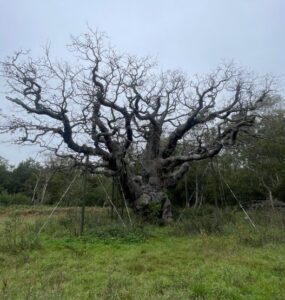
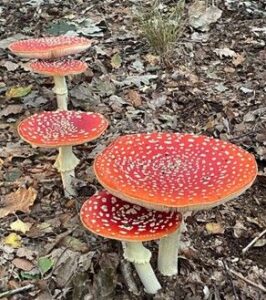
The Major Oak (left) and Amanita muscaria (fly agaric) toadstools (images: Matt Searle)

